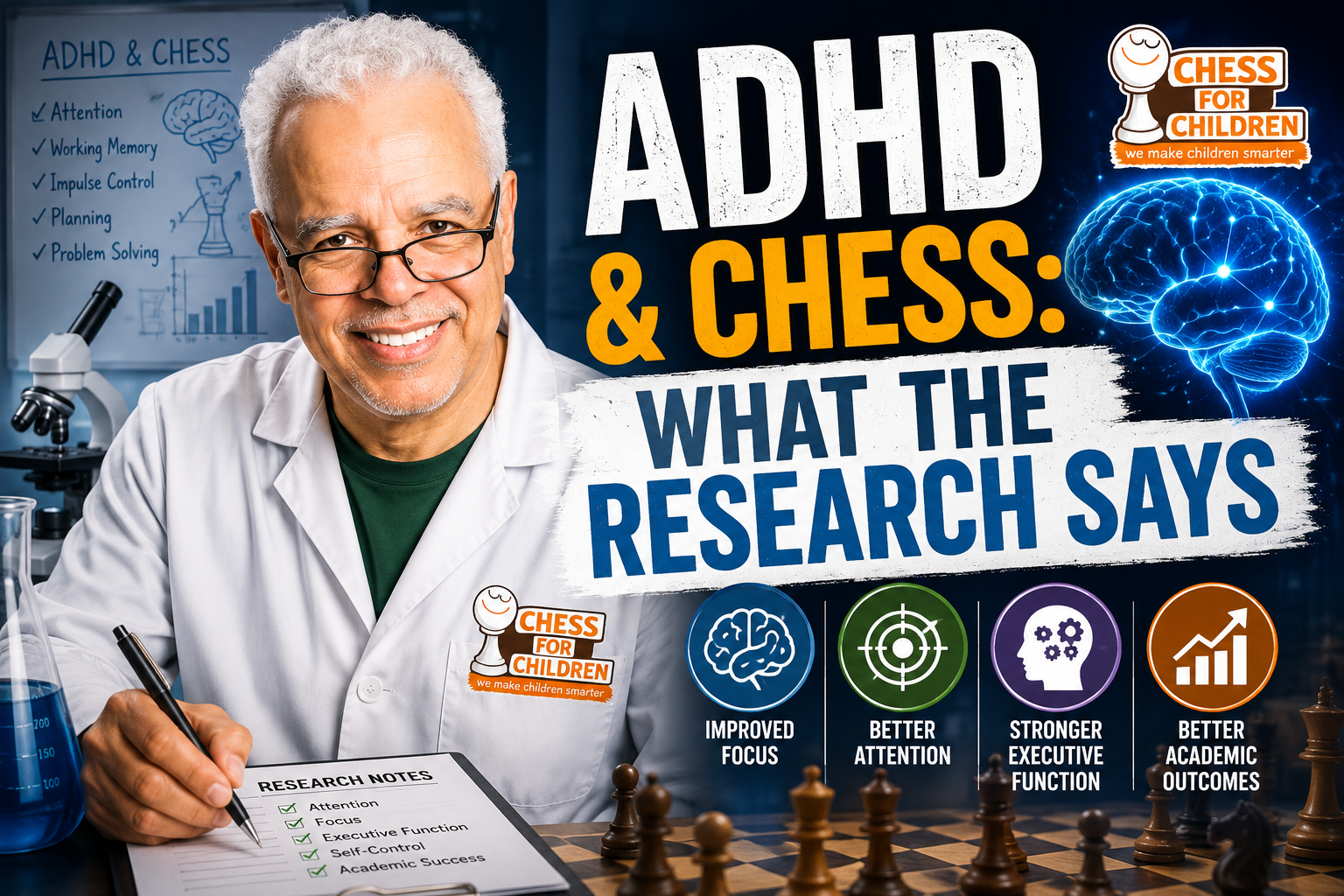
Does Chess Help Kids With ADHD?
What the Research Actually Says
By National Master Ernest Colding | Chess for Children | chessforchildren.com
I have been teaching chess to children for over 40 years.
In that time, I have worked with hundreds of children who have ADHD. Some were bouncing off the walls when they walked through my door. Some had already been told by teachers that they "couldn't focus." Some had tried sport after sport, activity after activity, and nothing had clicked.
Then they sat down at a chess board.
Within weeks — sometimes within days — I would see something shift. The fidgeting slowed. The impulsive moves gave way to a pause, a breath, a think. The child who "couldn't focus" was now sitting still for 45 minutes, completely absorbed.
I am not a doctor. I am a chess teacher. But over four decades, I have seen this pattern repeat itself so many times that I became curious: is there science behind what I'm seeing?
The answer, it turns out, is yes.
In this article, I want to walk you through what the research actually says about chess and ADHD — in plain English, not scientific language. No jargon. No complicated statistics. Just what the studies found and what it means for your child.
First, Let's Talk About What ADHD Does to a Child
If your child has ADHD, you already know that it's not about being naughty or lazy. ADHD is a brain-based condition that makes it genuinely hard for children to do three things:
- Stay focused on tasks that aren't immediately interesting
- Control their impulses — the urge to act before thinking
- Organize thoughts and plan ahead
These are called executive function skills. Think of them as the brain's self-management system. In children with ADHD, this system needs extra support to develop.
The challenge for parents is finding activities that actually help build these skills — not just activities that keep their child occupied. Those are two very different things.
This is where chess becomes interesting.
Why Chess? Isn't It Just a Game?
That's the question most parents ask me. And it's a fair one.
Chess looks like a game. But what your child's brain is doing while playing chess is much closer to exercise than entertainment.
Every single move in chess requires your child to:
- Stop and think before acting (instead of moving impulsively)
- Hold several possibilities in mind at once (working memory)
- Plan ahead — "If I move here, what happens next?"
- Stay focused on the board for the duration of the game
- Accept the consequence of each decision and adapt
Now read that list again and compare it to the challenges ADHD creates.
Chess isn't just compatible with what ADHD children need to develop — it is, almost by design, practice for the exact skills ADHD makes difficult.
But I didn't want you to take just my word for it. So let's look at what the studies say.
— National Master Ernest Colding, Chess for Children
What the Research Actually Says: 4 Studies Explained Simply
Let me take you through four published studies. I'll explain each one simply and then tell you what it means for your child.
"Chess training produced large, significant improvements in both attention AND hyperactivity — with or without medication."
Researchers in Spain worked with 44 children between the ages of 6 and 17, all diagnosed with ADHD. The children attended an 11-week chess training program. Parents completed standardized ADHD rating scales before and after the program.
The results were statistically significant across two different measurement scales. Children improved in both inattentiveness AND hyperactivity-impulsivity. What made this study particularly important is that the improvements happened in children on medication AND children who were not on medication. Chess helped both groups. The researchers concluded that chess "should be part of the multimodal treatment of ADHD."
If your child is currently on medication for ADHD, chess may add an extra layer of support. If your child is not on medication, chess may still help. Either way, the research suggests chess can be a useful tool — not instead of your doctor's advice, but alongside it.
"ADHD children who played chess stayed on task longer and improved their listening scores."
This study followed 14 students with ADHD, ages 11–13, who received chess training twice a week. Researchers measured how long children could focus before showing disruptive or off-task behavior, and also tested their ability to listen and follow instructions.
By the end of the program, children stayed focused for a measurably longer period before their attention broke down. Their listening comprehension scores also improved. While the sample was small, the direction of the findings matched what other studies have shown: regular chess practice extends the amount of time an ADHD child can hold their focus.
One of the most common complaints parents and teachers share with me about ADHD children is that they can't stay on task long enough to finish anything. This study suggests chess may be one of the few activities that genuinely trains that staying power — not just during the game, but in general.
"Chess players with ADHD were 3 times more likely to control their impulses than non-chess-playing peers with ADHD."
This is my favorite study because it used chess's own rules to test impulse control. In chess, there is a rule called the "touch-move" rule: if you touch a piece, you must move it. You cannot change your mind after touching a piece.
The researchers gave teenagers — both with and without ADHD — a task based on this rule. They wanted to see: who can resist the urge to act impulsively?
The results were striking. Children who had learned chess were significantly better at passing this test. In fact, learning chess increased the likelihood of passing the impulse control task by 3.08 times. ADHD on its own decreased the likelihood of passing by 2.70 times. But chess experience offset much of that ADHD disadvantage.
"Think before you move" is a rule in chess. But what this study shows is that chess trains children to apply that rule in their thinking automatically — not just on the board, but in life. For a child who acts before thinking, this is exactly what needs to be practiced.
"Children aged 5–6 who attended chess classes had significantly stronger working memory than their non-chess peers."
This study examined 5 and 6 year olds — some attending chess classes, some not — and measured multiple aspects of their thinking skills. Children in chess classes showed significantly higher scores in visuospatial working memory. This is the ability to hold visual information in your mind while you work with it — the same skill that's used when following multi-step instructions, doing mental math, or keeping track of what's happening in a conversation.
For children with ADHD, working memory is one of the most affected areas. This study suggests that chess, even at a young age, begins developing exactly this skill.
It is never too early. If your child is 4, 5, or 6 years old and showing signs of attention difficulties, introducing chess at this age may support the development of working memory during a critical window of brain growth.
What I've Seen With My Own Eyes Over 40 Years
Research confirms something I have watched happen in my classes for four decades.
Let me tell you about the kind of child I see regularly. A parent brings in a 7-year-old boy. He has been diagnosed with ADHD. He was asked to leave his soccer team because he couldn't follow the coach's instructions. He disrupts other children at school. His parents are exhausted and worried.
He sits down at the chess board. In the beginning, he moves too fast. He grabs pieces impulsively. He's not thinking — he's just reacting.
But here is what chess does that other activities don't: every impulsive move comes with an immediate and honest consequence. The other player takes his piece. He loses. The board tells him the truth instantly.
That feedback loop — move impulsively, face the consequence — is incredibly powerful for ADHD children. It is cleaner and more immediate than almost anything in real life.
Slowly, the child starts to pause before moving. Not because someone told him to. Because the game itself taught him that pausing pays off.
By week six or eight, something remarkable has usually happened. The parents come back and say: "I don't know what you're doing, but he's calmer. He's finishing his homework. His teacher said something has changed."
I have heard that conversation more times than I can count.
Chess doesn't just teach ADHD children to sit still for chess. It trains a mental habit — "stop, think, then act" — that gradually shows up in other areas of their lives.
The 3 Specific Ways Chess Helps ADHD Children
1. It Turns "Think Before You Move" Into a Habit
The core rule of chess is that every move must be deliberate. You cannot take it back. This forces children to practice the one thing ADHD makes most difficult: pausing before acting.
The more a child plays chess, the more this pause becomes natural. Researchers call this "inhibitory control." I call it the "stop and think" muscle. Chess builds it through thousands of repetitions, disguised as fun.
2. It Trains the Brain's Memory in a Way That Transfers to School
To play chess, your child must hold the position of multiple pieces in their mind, remember what happened two moves ago, and keep track of threats across the entire board. This is a demanding workout for working memory.
Working memory is essentially the brain's mental scratch pad. Children with ADHD often have a smaller or less reliable scratch pad than their peers. The Frontiers in Psychology study (2025) found that chess classes measurably expanded this capacity — even in very young children.
A stronger working memory means your child can hold the teacher's instructions in mind long enough to follow them. It means they can keep track of where they are in a homework problem. These are not chess skills — they are life skills that chess develops.
3. It Provides Immediate, Honest Feedback in a Safe Environment
One of the reasons ADHD is so hard to manage is that consequences in real life are often delayed. Your child acts impulsively at school, and the consequence — a note home, a detention — comes hours later. The brain doesn't easily connect the impulsive action to the distant consequence.
Chess compresses that feedback loop to seconds. Move without thinking — lose your queen. The connection between impulsive action and consequence is instant and clear.
Over time, this trains the brain to anticipate consequences before acting — which is exactly what ADHD makes difficult, and exactly what chess requires.
Is Chess Right for Your Child With ADHD?
I want to be honest with you: chess is not a magic cure. Not every child with ADHD will take to it immediately. Some children need a few weeks to get past the initial frustration of learning.
But in my experience, the children who stick with it — even just for a few months — almost always show meaningful improvement. The key is patient, structured teaching that meets your child where they are.
Here is what to look for in a chess program for a child with ADHD:
- Small class sizes or one-on-one instruction, so the child gets individual attention
- A teacher who is experienced with young children (not just competitive chess players)
- A calm, structured environment — not loud, chaotic, or competitive from day one
- A teacher who focuses on process ("why did you make that move?") rather than just winning and losing
- Patience — progress comes in weeks and months, not days
If you are wondering whether to start your child on medication, therapy, or chess — talk to your doctor. Chess is not a replacement for medical advice. But based on both the research and my own four decades of experience, it is one of the most effective complementary activities I know of for children who struggle with focus, impulsivity, and self-control.
The Short Answer
Does chess help kids with ADHD? Based on the research and what I have seen with my own eyes:
- Yes — chess significantly improves attention and reduces hyperactivity, according to a 2016 study of 44 ADHD children
- Yes — ADHD children who play chess are up to 3 times better at controlling impulses than ADHD peers who do not (Gindi & Pilpel, 2020)
- Yes — chess develops working memory in children as young as 5 years old (Frontiers in Psychology, 2025)
- Yes — chess works whether your child is on medication or not
But the most important thing I can tell you is this: I have watched it happen. For 40 years, I have watched children who were told they "couldn't focus" sit completely still at a chess board, thinking deeply, growing quietly.
Chess doesn't require your child to be a certain type of learner. It meets them exactly where they are and challenges them to grow.
That is why I have spent my life teaching it.
Want to Try Chess for Your Child With ADHD?
At Chess for Children, we specialize in teaching children ages 4–12. Our programs are designed to be patient, structured, and genuinely fun — even for children who have struggled to focus in other activities.
► Private chess lessons • Online chess courses • School chess programs • Chess clubs
References & Research Sources
Study 1: Blasco-Fontecilla, H., Gonzalez-Perez, M., Molina-Caballero, C., et al. (2016). Efficacy of chess training for the treatment of ADHD: A prospective, open label study. Revista de Psiquiatría y Salud Mental (English Edition). https://pubmed.ncbi.nlm.nih.gov/25911280/
Study 2: Bakker, T. C. M. (2015). The Effect of Playing Chess on the Concentration of ADHD Students in the 2nd Cycle. Procedia — Social and Behavioral Sciences, 191, 523–526. https://www.sciencedirect.com/science/article/pii/S187704281503582X
Study 3: Gindi, S., & Pilpel, A. (2020). Pièce Touchée! The Relationship Between Chess-Playing Experience and Inhibition. Psychology in Russia: State of the Art, 13(1), 133–146. https://psychologyinrussia.com/volumes/?article=8446
Study 4: Chess classes and executive function skills in 5–6 years old children: evidence from cross-sectional study. (2025). Frontiers in Psychology. https://www.ncbi.nlm.nih.gov/pmc/articles/PMC12318946/
Additional source: FIDE (2021). Chess as a tool to fight Attention Deficit Hyperactivity Disorder. International Chess Federation. https://www.fide.com/chess-as-a-tool-to-fight-attention-deficit-hyperactivity-disorder/
Note: This article is for informational purposes only. Chess is not a medical treatment. If your child has ADHD, please consult a qualified healthcare professional regarding diagnosis and treatment options.