Does Chess Improve Math Skills? What the Research Actually Shows
By National Master Ernest Colding
Research Verdict:
The strongest evidence suggests that chess can improve mathematical performance when students receive at least 25-30 hours of quality instruction.
The largest gains appear in programs that run for an entire school year and among students who initially struggle in mathematics.
Parents and school administrators ask me this question more than any other:
does chess actually make kids better at math?
It is a fair question. Chess looks like a game. Math is a subject. Why would playing one improve performance in the other?
does chess actually make kids better at math?
It is a fair question. Chess looks like a game. Math is a subject. Why would playing one improve performance in the other?
I have taught chess to thousands of children over forty years in Brooklyn schools, libraries, and after-school programs. I have watched many of them become stronger math students. But my observations are not evidence. Research is evidence.
Here is what the studies actually say — the strongest findings, the weaker ones, and what any parent or school administrator needs to know before making a decision.
The Strongest Evidence: Gaudreau’s Three-Year Study
The most compelling mathematics study in chess education research comes from Canada.
Researcher Louise Gaudreau followed elementary school students across three academic years, comparing children who received structured chess instruction to those who did not.
Researcher Louise Gaudreau followed elementary school students across three academic years, comparing children who received structured chess instruction to those who did not.
The results were striking.
Chess students improved from a baseline of 62% to 81.2% in mathematics assessments — a gain of 19.2 percentage points over the study period. When compared against the control group’s trajectory, chess-instructed students held a 21.46 percentage point advantage by the end of the third year.
This is not a marginal effect. A 21-point advantage in mathematics over three years is a meaningful and educationally significant result.
What makes Gaudreau’s study particularly credible:
Multi-year design — not a brief intervention measured immediately after
Comparison group — allowing calculation of the actual chess effect vs. normal development
Sustained instruction — students received regular chess lessons across the full school year
Trinchero’s Italy Study: Chess Benefits Lower-Attaining Students Most
Italian researcher Roberto Trinchero conducted a study examining chess instruction and mathematics performance that produced a finding most educators find surprising.
Students who started with lower mathematics performance showed greater gains than their higher-achieving peers after chess instruction.
This is the reverse of what most enrichment activities produce. Typically, students who already perform well benefit most from enrichment, while struggling students see smaller effects.
This is the reverse of what most enrichment activities produce. Typically, students who already perform well benefit most from enrichment, while struggling students see smaller effects.
Trinchero’s finding suggests that chess may be particularly valuable as a support tool for students who find traditional mathematics instruction difficult.
The game provides a different entry point — one built around problem-solving, pattern recognition, and logical reasoning rather than memorization
The game provides a different entry point — one built around problem-solving, pattern recognition, and logical reasoning rather than memorization
The Venezuela Study: Scale Across Thousands of Students
One of the largest chess education studies ever conducted took place in Venezuela. Researchers examined 4,266 students who participated in a national chess instruction program.
After just 4.5 months of instruction, students demonstrated measurable gains in IQ scores and cognitive ability measures. While this study focused on general cognitive development rather than mathematics specifically, the reasoning and problem-solving skills it measured are directly connected to mathematical performance.
The significance of the Venezuela study is its scale. Results from 4,266 students across a national program are harder to dismiss as a local anomaly. When improvements appear consistently across thousands of students from different schools and backgrounds, the pattern carries more weight.
.
What the Meta-Analysis Found: The 25-Hour Threshold
In 2016, researchers Giovanni Sala and Fernand Gobet published a meta-analysis examining 24 separate chess education studies, including several focused on mathematics performance.
A meta-analysis pools results across multiple studies to identify patterns that individual studies cannot reveal. Their key finding for mathematics:
Chess instruction improves mathematics performance — but only when students receive at least 25 to 30 hours of instruction. Programs shorter than this threshold showed weak or no academic effects.
Twenty-five to thirty hours works out to approximately one lesson per week across a full school year. This means brief chess workshops, one-week intensives, or short-term programs are unlikely to produce the academic gains that sustained, year-long programs deliver.
This finding has direct implications for schools considering chess programs. Commitment matters. An after-school chess club that meets once a week for a full school year is substantially different from a six-week introductory program.
.
Why Might Chess Improve Math Skills?
Researchers have proposed several explanations for the observed connection between chess and mathematics:
Pattern Recognition
Chess players learn to recognize recurring patterns — tactical motifs, piece configurations, structural features. Mathematics also relies heavily on pattern recognition. Students who practice identifying patterns in one domain may strengthen this ability across domains.
Logical Reasoning
Every chess move requires cause-and-effect reasoning: if I move here, my opponent can respond there, which leads to this position. This sequential logical thinking overlaps with the reasoning required to solve multi-step math problems.
Spatial Reasoning
Chess requires players to visualize positions and calculate sequences of moves without physically moving pieces. This spatial reasoning ability is closely related to the geometric and algebraic thinking required in mathematics.
Working Memory
Calculating chess variations requires holding multiple possibilities in mind simultaneously. Working memory capacity is one of the strongest predictors of mathematics achievement, and chess provides a rigorous, engaging workout for this cognitive skill.
An Honest Assessment of the Evidence
Not every study has found a positive effect. The 2015 Institute of Education Sciences (IOE) randomized controlled trial in the United Kingdom — the largest chess education study ever conducted, covering 3,865 students — found no significant academic improvement over a passive control group.
I include this result because educators deserve complete information. The IOE study is methodologically rigorous and cannot be dismissed.
However, the IOE study used a shorter intervention than the programs that produced the strongest effects. The 25-30 hour threshold identified by Sala and Gobet’s meta-analysis is relevant here. Duration, consistency, and instructor quality all appear to matter significantly.
The weight of evidence across multiple studies conducted over five decades suggests that well-implemented, sustained chess instruction can improve mathematical reasoning. The key phrase is well-implemented and sustained. Brief, low-quality programs are unlikely to produce academic results.
What I Have Observed After 40 Years of Teaching
Research confirms what I have witnessed in classrooms and after-school programs across Brooklyn for four decades.
Students who study chess regularly become more comfortable with multi-step problems. They learn to break a complex situation into smaller parts, evaluate each option, and commit to a decision. These are mathematical habits of mind.
I have also observed the Trinchero effect firsthand. Children who struggle in traditional classroom settings often thrive in chess. The game meets them where they are. It rewards logical thinking over memorization, and many students who have been told they are “not math people” discover through chess that they think analytically after all.
That discovery can change the trajectory of a child’s relationship with mathematics.
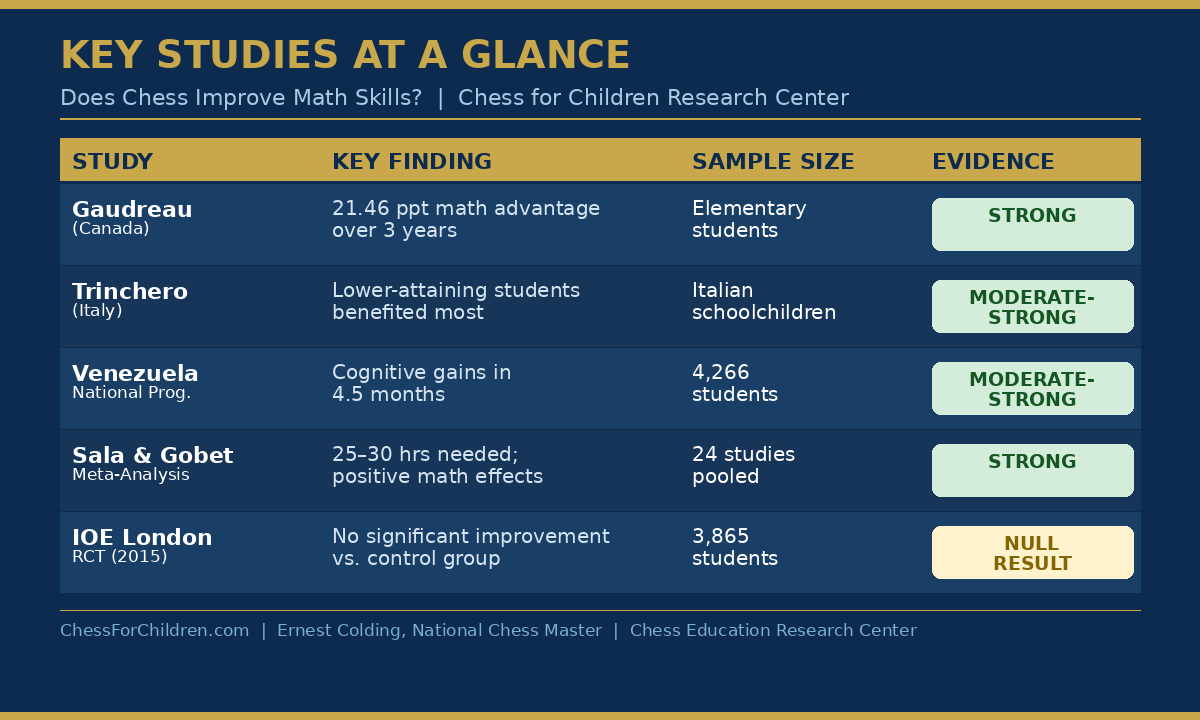
Key Studies at a Glance
The Bottom Line for Parents and Schools
Based on five decades of research, here is what the evidence supports:
Sustained chess instruction — at least one lesson per week across a full school year — is associated with meaningful mathematics gains in multiple peer-reviewed studies.
The cognitive skills chess develops — pattern recognition, logical reasoning, working memory, and spatial thinking — are directly connected to mathematical performance.
Students who struggle in traditional math may benefit disproportionately from chess instruction.
Short programs are unlikely to produce measurable academic effects.
Duration and consistency are critical.
Chess for Children brings research-based chess instruction to schools across Brooklyn and New York City.
Our programs are designed to meet the 25-30 hour threshold the research identifies as necessary for academic benefit. →
Sustained chess instruction — at least one lesson per week across a full school year — is associated with meaningful mathematics gains in multiple peer-reviewed studies.
The cognitive skills chess develops — pattern recognition, logical reasoning, working memory, and spatial thinking — are directly connected to mathematical performance.
Students who struggle in traditional math may benefit disproportionately from chess instruction.
Short programs are unlikely to produce measurable academic effects.
Duration and consistency are critical.
Chess for Children brings research-based chess instruction to schools across Brooklyn and New York City.
Our programs are designed to meet the 25-30 hour threshold the research identifies as necessary for academic benefit. →
Related Research
Chess and Critical Thinking: What 50 Years of Studies Show
Chess and ADHD: The 2023 RCT That Changed the Conversation
Chess and Reading Achievement: Margulies and Beyond
The Complete Research Behind Chess Education: What 50 Years of Studies Reveal
More reading:
School Chess Programs
Private Lessons
Scholastic chess research Center
Jess's Chess Adventure
Chess Mastermind Club
Copyright © 2026
Created with