Does My Child Need a Chess Coach? What Parents Should Know About Cost, Coaching, and Real Improvement
By National Master Ernest Colding
One of the most common questions parents ask me is:
"Does my child need a chess coach?"
Usually, that question is followed by another:
"And how much should chess lessons cost?"
After teaching more than 10,000 children over the past 40 years, I've learned that the answer to the first question is much more important than the second.
Before parents worry about cost, they need to determine whether coaching is actually the right next step for their child.
The truth is that not every child needs private lessons.
But for some children, a coach can completely change the trajectory of their chess development.
The Two Things Every Child Needs to Benefit From a Chess Coach
In my experience, there are two requirements.
1. The Child Must Love Chess
This is the most important ingredient.
A coach cannot create passion.
The child should enjoy playing chess, solving puzzles, talking about chess, and learning new ideas.
They don't need to be a champion.
They simply need to love the game.
When a child loves chess, practice becomes enjoyable rather than a chore.
2. The Child Must Have Ambition
The second ingredient is ambition.
The child must want to improve.
Maybe they want to win more games.
Maybe they want to make the school team.
Maybe they dream of becoming a champion.
The specific goal doesn't matter.
What matters is that the desire comes from the child.
A coach can provide guidance, structure, accountability, and expertise, but the student must bring the motivation.
When love of the game and ambition come together, remarkable things can happen.
When Group Classes Are No Longer Enough
Many children can learn successfully through school chess clubs and after-school programs.
In fact, I strongly recommend group classes for most beginners.
Group classes are wonderful because children:
Learn the fundamentals
Make friends
Develop confidence
Discover whether they truly enjoy chess
However, there comes a point when some students outgrow what a group environment can provide.
I remember a father approaching me after one of our school chess programs.
His two sons loved chess.
They attended every class.
They played constantly.
They were among the strongest players on the team.
Yet their progress had stalled.
The father asked me:
"Why aren't my boys getting any better?"
My answer surprised him.
I told him that his sons were not lacking talent.
In fact, they were two of the most talented students in the program.
The problem was that they had already outgrown the group class.
Consider a typical after-school chess program.
There may be 20 to 30 students in a 90-minute class.
Even with an excellent instructor, each child may receive only a few minutes of individual attention.
That isn't a criticism of group instruction.
It's simply reality.
Once a student reaches a certain level, they need personalized feedback.
They need someone who can examine their games, identify weaknesses, design exercises, and create a training plan specifically for them.
That's what private coaching provides.
The father decided to enroll both boys in private lessons.
The results were remarkable.
Both boys eventually became National Champions.
The younger brother went on to earn the title of Master.
Their success wasn't because they suddenly became more talented.
It was because they received focused instruction that addressed their specific needs.
What Does a Chess Coach Actually Do?
A good coach doesn't simply teach openings.
A good coach:
Identifies weaknesses
Builds on strengths
Analyzes tournament games
Creates personalized exercises
Develops thinking skills
Builds confidence
Provides accountability
Think of a coach as a personal trainer for the mind.
Instead of strengthening muscles, a chess coach strengthens decision-making, calculation, focus, and problem-solving.
How Much Do Chess Lessons Cost?
The cost of coaching varies considerably.
Generally speaking, parents can expect the following:
Group Classes
$15–$50 per session
School Chess Programs
Often subsidized by schools or PTAs
Sometimes free
Often $100–$500 per semester
Online Lessons
$30–$100 per lesson
Private Chess Coaches
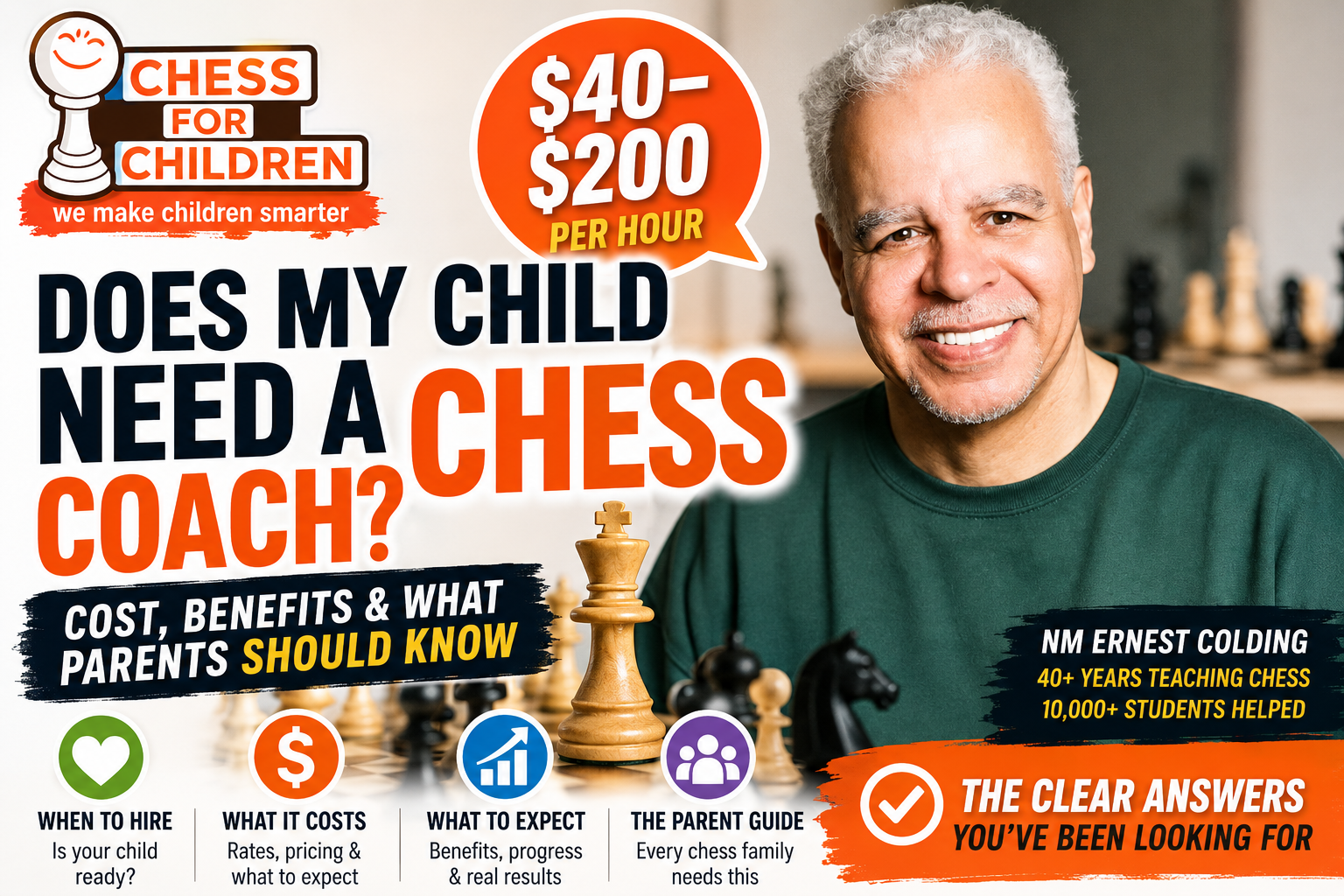
$40–$200+ per hour
The most expensive coach is not always the best coach.
I've known excellent teachers who charge modest fees and strong players who struggle to teach children effectively.
When evaluating a coach, parents should focus on teaching ability, communication, and results—not just playing strength.
Signs Your Child May Be Ready for Private Lessons
Your child may benefit from coaching if:
They love chess.
They actively want to improve.
They have become one of the strongest players in their group class.
They are playing tournaments regularly.
Their progress has plateaued.
They ask deeper questions than the class can address.
Signs Your Child May Not Need a Coach Yet
Your child may be better served by group instruction if:
They just learned the rules.
They are still exploring whether they enjoy chess.
They prefer learning with friends.
They are not interested in competition.
There is no rush.
Chess is a lifelong game.
My Recommendation After 40 Years
Most children should start with:
School chess clubs
After-school programs
Group classes
Friendly competition
These environments provide an excellent foundation.
Private coaching becomes valuable when a child has both:
A genuine love for chess.
A strong desire to improve.
When those two ingredients are present, a coach can make an enormous difference.
The goal isn't simply to create stronger chess players.
The goal is to help children become stronger thinkers.
As I often tell my students:
"Thinking beats everything."
Ready to Find Out What's Right for Your Child?
Chess for Children has helped more than 10,000 students build confidence, critical thinking skills, and a lifelong love of learning through chess.
Whether your child is just beginning or ready for advanced coaching, we can help you determine the best path forward.