How Long Does It Take a Child to Learn Chess? A National Master's 40-Year Answer
By National Master Ernest Colding
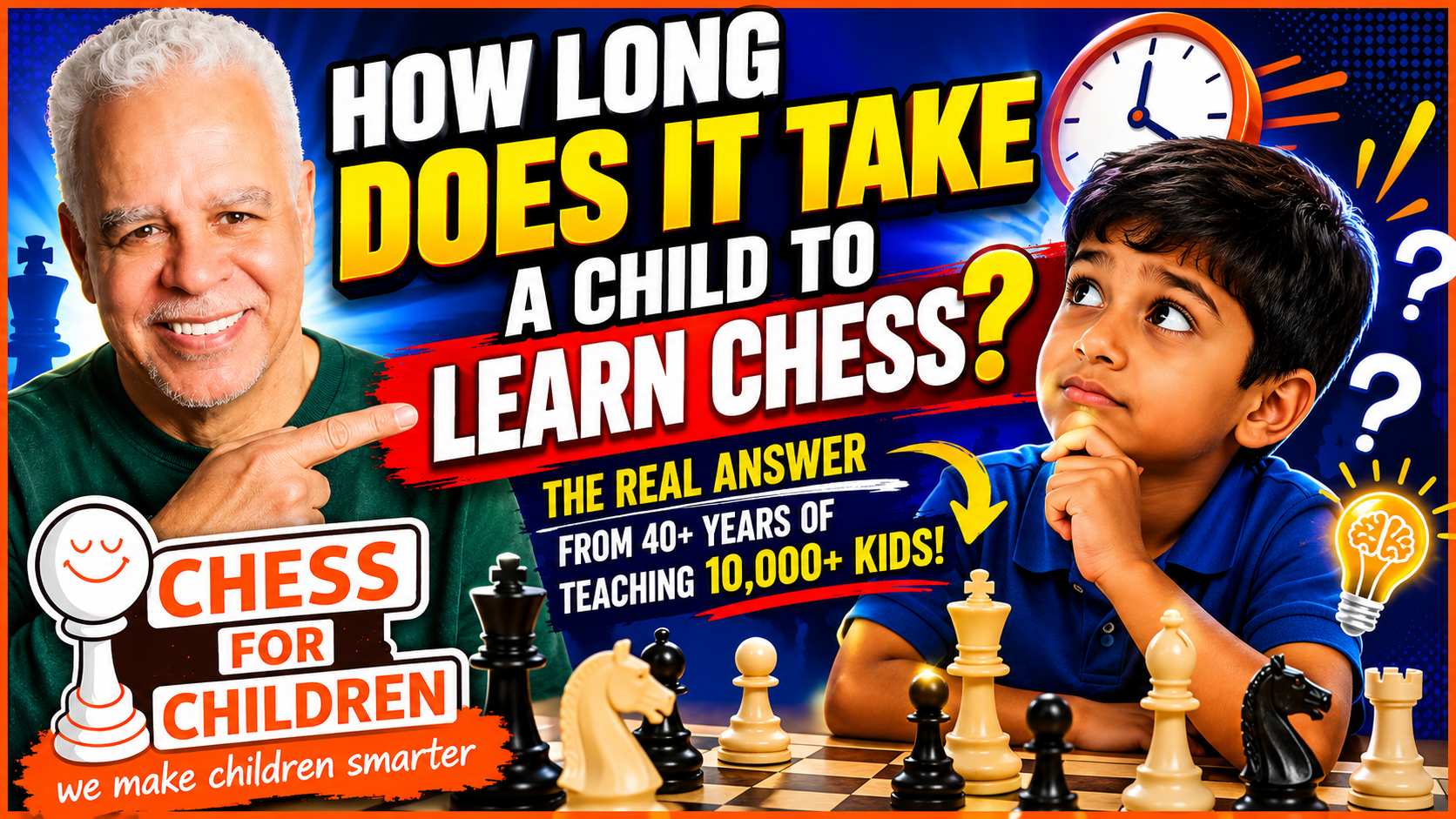
One of the most common questions parents ask me is:
"How long will it take my child to learn chess?"
The short answer is:
Most children can learn how the pieces move in two or three lessons. Some children learn in a single day.
But that answer is misleading.
It's a little like asking:
"How long does it take to learn music?"
Do you mean learning where the notes are?
Playing a simple song?
Performing at Carnegie Hall?
The same is true of chess.
Before we can answer how long it takes to learn chess, we must first answer:
What do you mean by "learn chess"?
Stage 1: Learning the Rules (Usually 1–3 Lessons)
The first stage is simply learning:
- How the pieces move
- How pieces capture
- What check means
- What checkmate means
- How castling works
- Basic game etiquette
Most children learn these fundamentals very quickly.
When I teach private lessons, many children understand all the piece movements after only one or two sessions.
Some children learn the basics in a single afternoon.
The rules of chess are actually simple.
The challenge comes afterward.
Stage 2: Learning to See the Board (Several Weeks to Several Months)
This is where real chess begins.
Many beginners know how the pieces move but have no idea what is happening on the board.
They don't yet see:
- Attacks
- Threats
- Defended pieces
- Tactical opportunities
- Checkmate patterns
A child may know a bishop moves diagonally yet still leave it hanging.
Why?
Because chess isn't about moving pieces.
It's about seeing relationships between pieces.
The eye must be trained.
This takes practice.
Stage 3: Learning Patterns (Months to Years)
Strong players don't calculate everything.
They recognize patterns.
They instantly notice:
- Forks
- Pins
- Skewers
- Double attacks
- Checkmate threats
- Weak squares
This is similar to reading.
A beginning reader sounds out letters.
An experienced reader recognizes whole words.
Chess works the same way.
The more patterns a child learns, the stronger they become.
Stage 4: Learning How to Think
This is the stage most parents never consider.
Chess is not merely about moves.
It is about decisions.
Children learn to ask:
- What is my opponent threatening?
- What are my choices?
- Which move is best?
- Why is it best?
- What is my plan?
This is where chess becomes a powerful educational tool.
The child isn't just learning chess.
The child is learning how to think.
The Chess Challenge Method
Over the years I developed a teaching system called the Chess Challenge.
The idea is simple.
Children don't learn best by listening.
Children learn best by doing.
Each lesson contains four stages:
1. Introduce the Topic
Students learn a new chess idea.
2. Introduce a Memory Device
A mnemonic, story, rhyme, or visual image helps students remember the lesson.
3. Review Through Questions
Questions reinforce understanding and build confidence.
4. The Challenge
Students immediately put the idea into practice against opponents.
Knowledge becomes skill through use.
This system allows children to learn concepts remarkably quickly because they are actively involved in the learning process.
Why Some Children Learn Faster Than Others
Parents often ask:
"Is my child learning fast enough?"
Every child learns differently.
Factors include:
- Age
- Attention span
- Prior experience
- Confidence
- Interest level
- Frequency of practice
I've taught children who understood the game in a single day.
I've also taught children who needed weeks to become comfortable.
Neither situation predicts future success.
Some of the strongest players I've coached were not the fastest learners.
They were simply the most persistent.
How Long Does It Take to Become Good at Chess?
This depends entirely on the goal.
Learn the Rules
1–3 lessons
Play a Complete Game
Several days to several weeks
Understand Basic Tactics
Several months
Compete in Tournaments
Several months to a year
Become a Strong Scholastic Player
Several years
Master Chess
A lifetime
And that brings us to the most important point.
Chess Is the Gymnasium of the Mind
There is another reason the question "How long does it take to learn chess?" is difficult to answer.
Chess is not simply a game.
Chess is the gymnasium of the mind.
Birds fly.
Fish swim.
Horses run.
Eagles soar.
Human beings think.
Thinking is what human beings do best.
When children play chess, they are exercising the very ability that makes us uniquely human.
They are learning to:
- Analyze
- Compare
- Plan
- Solve problems
- Make decisions
- Think before acting
Every game is a workout for the mind.
The more children exercise these abilities, the stronger they become.
Just as athletes train their muscles, chess players train their thinking.
That is why chess is far more than a game.
It is practice for life.
So How Long Does It Take to Learn Chess?
If your goal is to learn how the pieces move, the answer may be only a few lessons.
If your goal is to play confidently, the answer may be a few months.
If your goal is to become a strong player, the answer may be several years.
If your goal is to understand everything chess has to teach, the journey never truly ends.
There is an old saying:
"Chess is a pond in which a mosquito can drink and an elephant can drown."
The rules are simple enough for a child.
The depth is great enough to challenge a lifetime.
And that is precisely why chess remains one of the greatest educational tools ever created.
About the Author
National Master Ernest Colding has spent more than 40 years teaching chess to children. He has taught over 10,000 students, coached more than 30 national champions, authored multiple chess books, and developed innovative teaching methods used in schools, camps, clubs, and private lessons throughout New York City and beyond.