Can a 3-year-old really learn chess?
Yes—but I don't teach a 3-year-old the same way I teach an older child.
I've spent more than 40 years teaching chess to children, and one of the most important things I've learned is that very young children learn best when chess is presented in small, simple and memorable steps.
So let's begin with the most important piece on the chessboard: the King.
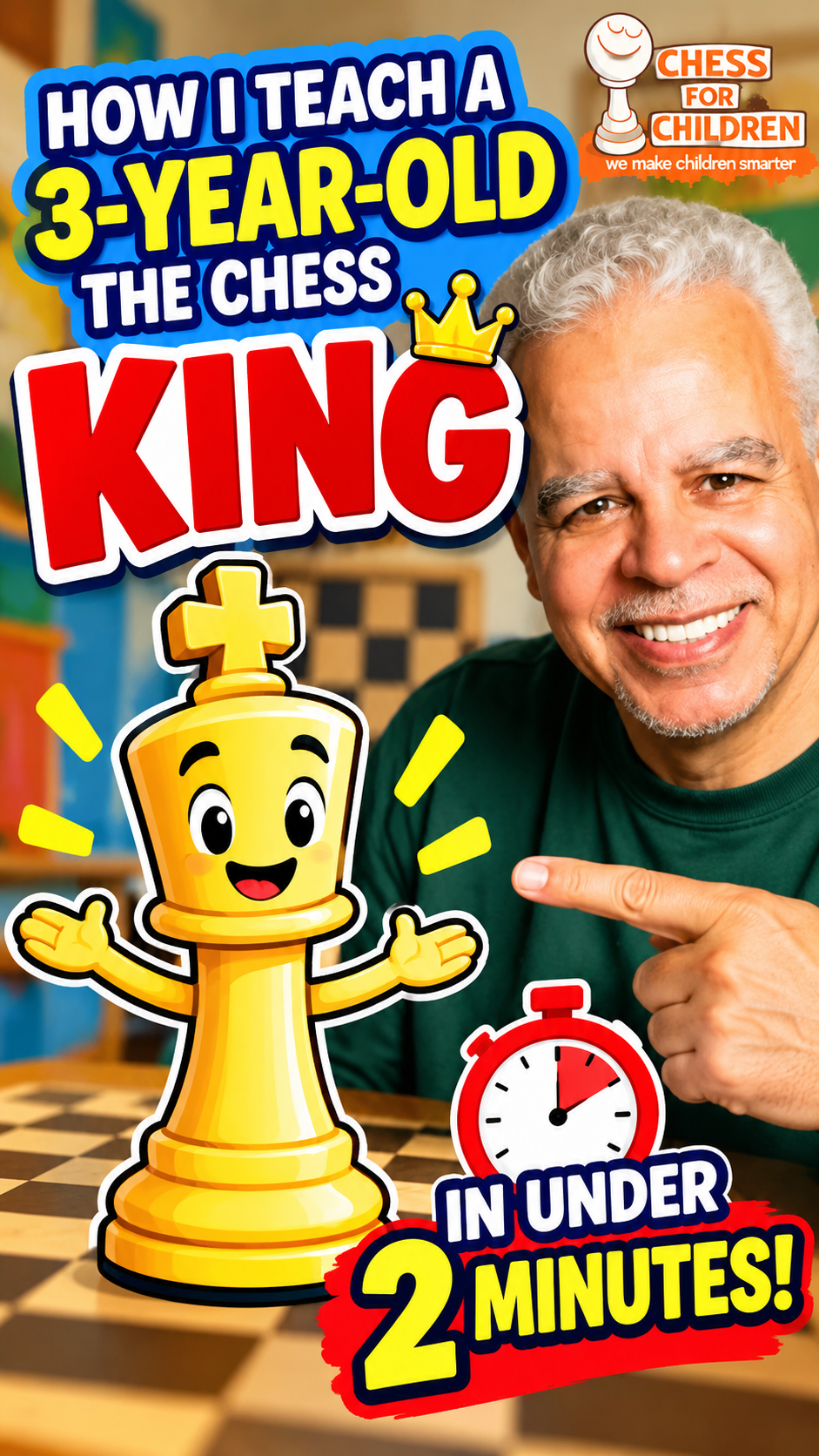
Watch Me Teach a 3-Year-Old the Chess King
Here's my quick lesson showing how I introduce the King to a very young child.
How Do You Teach the Chess King to a 3-Year-Old?
When I'm teaching a very young child, I don't begin with a long explanation about check, checkmate, legal positions or chess notation.
I want the child to understand one simple idea:
The King can move forward, backward, sideways or diagonally—but only one square at a time.
For a 3-year-old, that's enough for our first lesson.
Try This Simple Chess Exercise With Your Child
Put the King near the center of an otherwise empty chessboard.
Then ask your child one simple question:
“Where can the King go?”
Let your child point to a square.
Then let your child pick up the King and actually move it.
If your child makes a mistake, don't turn the lesson into a test. Simply show the move again and let your child try another time.
For very young children, touching the pieces, moving them and discovering the answer can be much more effective than listening to a long explanation.
Don't Try to Teach the Whole Game
This is one of the most important suggestions I can give parents who want to introduce chess to a preschool child.
Your 3-year-old doesn't need to learn everything at once.
You don't need to teach openings, castling, notation, strategy, tactics and checkmate during the first lesson.
Instead, teach one thing successfully.

My Teaching Philosophy: Thinking Beats Everything
I've spent more than four decades teaching children chess, and my teaching philosophy can be summed up in three words:
I don't want children simply memorizing where somebody told them to move.
I want them to look, think, discover and make decisions.
Even at three years old, we can begin developing that habit.
That's one of the reasons chess can be such a powerful educational tool for young children.
Can Your 3-Year-Old Learn Chess?
Try today's King exercise and find out.
Take out a chessboard, put the King in the center and ask your child where the King can move.
Keep the lesson short. Keep it fun. And give your child plenty of opportunities to make the moves.
When your child understands that the King moves one square at a time, you've accomplished today's goal.
How I Teach a 3-Year-Old Chess
This lesson is part of my How I Teach a 3-Year-Old Chess series for parents.
We'll introduce the chess pieces one at a time—the King, Queen, Rook, Bishop, Knight and Pawn—using simple lessons designed for very young children.
The goal isn't to see how much chess a child can memorize. The goal is to get the child interested in looking, thinking and learning.
About National Master Ernest Colding
Ernest Colding is a National Master and Life Master and the founder of Chess for Children.
He has spent more than 40 years teaching children chess and is the author of Teach Your Child Chess in Ten Easy Lessons.
Would You Like Help Teaching Your Child Chess?
Every child learns differently.
Talk with National Master Ernest Colding about your child's age, experience and the best way to begin learning chess.
Schedule a free 15-minute chess consultation.
Book My Free 15-Minute ConsultationWhat's Next?
Continue following the How I Teach a 3-Year-Old Chess series as we introduce the other chess pieces with short, parent-friendly lessons.
Next, we'll continue building your child's chess knowledge one simple step at a time.