How to Teach Your Child Checkmate: Why Understanding Always Beats Memorization
The Detective Method That Has Helped Thousands of Children Learn Chess
Founder, Chess for Children
"Memory Is Like a Bad Friend."
One of the first things I tell every new chess student is:
"Memory is like a bad friend. He's never there when you need him."
The children usually laugh.
Then I ask them two questions that change the way they think about learning forever.
First I ask:
"What did you have for lunch last Wednesday?"
Almost every child does exactly the same thing.
Their eyebrows go up.
Their eyes look toward the ceiling.
They stop talking.
They're searching.
Sometimes they eventually remember.
Sometimes they don't.
Then I smile and say,
"See? That's memory."
Memory is like searching through a giant filing cabinet.
Sometimes you find the answer.
Sometimes it takes a while.
Sometimes the answer simply isn't there.
Then I ask a second question.
"What does one plus one equal?"
Without hesitation every child answers,
"Two!"
No searching.
No looking at the ceiling.
No pause.
The answer comes immediately.
Then I tell them,
"See? That's understanding."
When you truly understand something, you don't have to search for the answer.
You already know why it works.
That simple lesson forms the foundation of everything I teach.
Chess Is Not a Memory Contest
Many parents believe strong chess players simply remember more moves.
Nothing could be further from the truth.
Great chess players understand ideas.
They recognize patterns.
They solve problems.
For over 40 years, I have taught more than 10,000 children how to play chess.
I've coached beginners, school champions, state champions, and national champions.
The strongest players were never the ones with the best memories.
They were the ones who learned how to think.
That is why I never teach checkmate as something to memorize.
I teach it as a mystery to solve.
First We Must Understand What Checkmate Is
Many children know the word "checkmate."
Very few truly understand what it means.
The definition is surprisingly simple.
Checkmate is when the king is under attack and has absolutely no legal way to escape.
That's it.
Everything else grows from that one idea.
The Three Ways Every King Escapes Check
Whenever a king is attacked, there are only three possible ways to survive.
1. Capture the Attacking Piece
If the king (or another piece) can safely capture the attacking piece...
The check disappears.
2. Block the Attack
If another piece can move between the attacking piece and the king...
The attack is stopped.
3. Run Away
If the king can move to a safe square...
The game continues.
Now comes the important part.
If the king cannot:
- capture the attacker,
- block the attack,
- or run away,
the game is over.
That is checkmate.
Notice something important.
We haven't memorized a single position.
We've simply understood the rules.
Understanding always comes before memorization.
Meet Magnus the Checkmate Detective
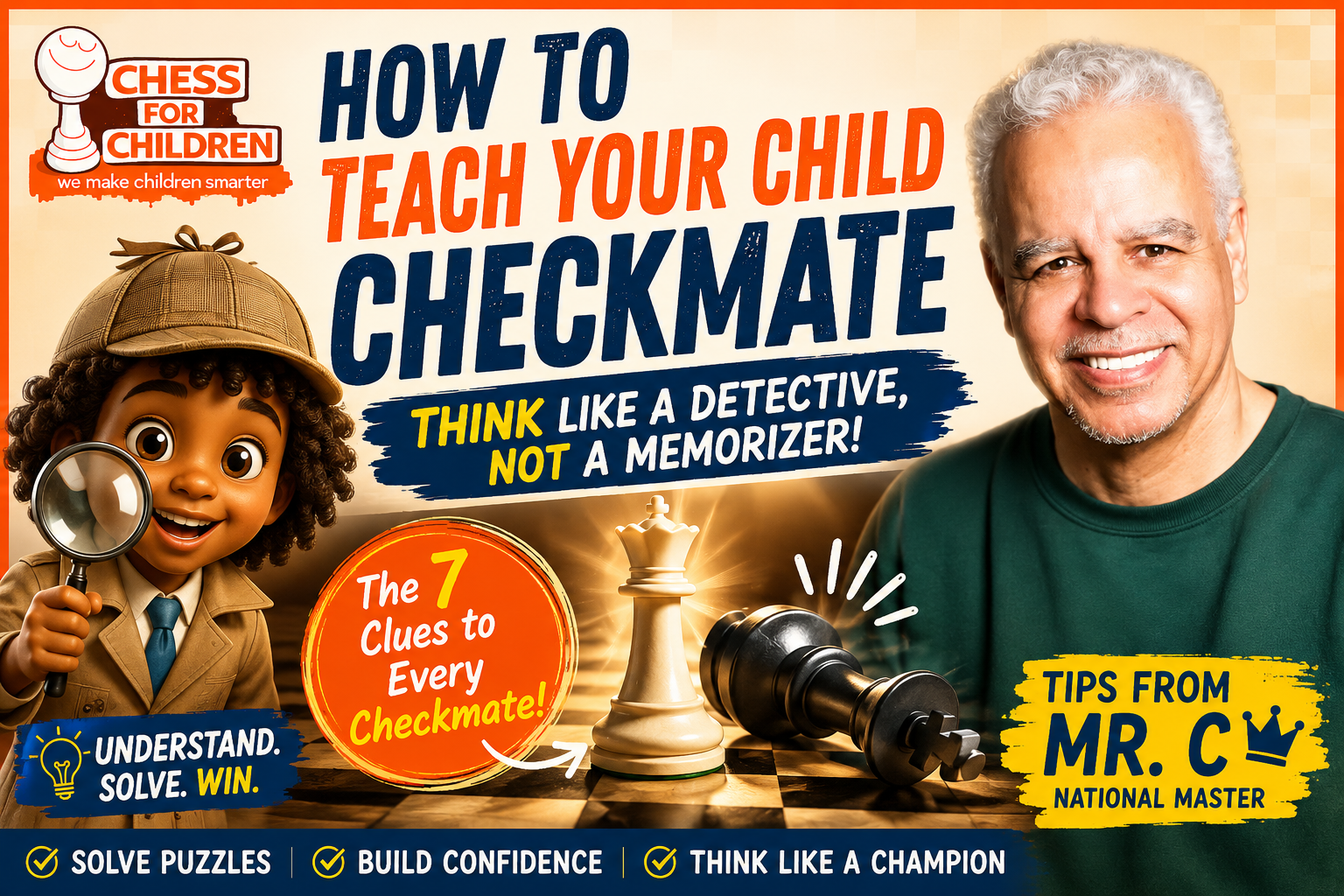
Inside our Chess Mastermind Club, children meet Magnus the Checkmate Detective.
Magnus teaches children that every checkmate is really a mystery.
Instead of asking,
"Have I seen this position before?"
Magnus asks,
"What clues does the position give me?"
That one question changes everything.
Chess becomes detective work.
The Seven Clues to Every Checkmate
Every mystery leaves clues.
So does every checkmate.
Whenever my students search for a checkmate, they follow seven simple clues.
Clue #1
How Many Squares Does the King Have?
Every king wants somewhere to run.
Count the safe squares.
The fewer escape squares the king has...
The closer you are to checkmate.
Never make a move before counting.
Clue #2
What Kind of Line Is the King On?
Is the king:
- in the middle?
- on the side?
- on the edge?
- trapped in the corner?
A king in the center has many escape routes.
A king in the corner has very few.
Immediately you know how difficult your job will be.
Clue #3
What Color Are the Escape Squares?
Many children never notice this.
Sometimes every escape square is light.
Sometimes they're all dark.
Sometimes they're mixed.
This clue often tells us which bishop, queen, or knight will become important.
Great chess players notice these patterns.
Clue #4
Which Pieces Can Take Those Squares Away?
Now ask yourself,
Which of my pieces controls those escape squares?
Perhaps:
- the queen
- the rook
- a bishop
- a knight
- even your own king
Now you're building a plan instead of guessing.
Clue #5
What's Stopping Me?
Sometimes we already know how to checkmate.
Something is simply in the way.
Maybe it's:
- a rook
- a bishop
- a knight
- a pawn
- even one of our own pieces
Good detectives always identify the obstacle first.
Clue #6
Can I Remove the Obstacle?
Once we know what's stopping us...
We ask,
Can we:
- capture it?
- distract it?
- force it away?
- sacrifice something?
Many beautiful combinations begin with this simple question.
Clue #7
Follow the Clues
Only now do we calculate.
Notice what never happens.
We never ask,
"Do I remember this position?"
Instead we ask,
"What do the clues tell me?"
That is how strong chess players think.
Understanding Before Patterns
Only after children understand how checkmate works do we begin teaching the classic mating patterns.
This order is extremely important.
Too many students memorize the patterns before they understand why they work.
Eventually they forget.
Understanding lasts forever.
The Essential Checkmates Every Child Should Know
Once children understand the detective process, we introduce the classic checkmates.
These include:
♕ King and Queen
♖ King and Rook
♕ Two Queens
♖ Ladder Mate
♗ Two Bishops
♗♘ Bishop and Knight
Each one is learned as another mystery to solve—not another position to memorize.
Practice Is Where Understanding Becomes Skill
Reading about checkmate isn't enough.
Watching someone else solve puzzles isn't enough.
Children must practice.
But even practice should encourage thinking.
Every new position should ask,
- How many escape squares?
- What line is the king on?
- What color are the squares?
- Which pieces can take them away?
- What's stopping me?
- Can I remove the obstacle?
Soon children stop looking for moves.
They start looking for clues.
That is exactly what we want.
Introducing the FREE Chess Challenge
To help children practice this way of thinking, we've created our FREE Interactive Chess Challenge.
Instead of staring at diagrams in a book, children solve real checkmate puzzles on an interactive chessboard.
They can practice:
- King and Queen Checkmate
- King and Rook Checkmate
- Two Bishops
- Bishop and Knight
- Ladder Mate
- and many more.
Every puzzle encourages observation, investigation, and problem solving.
Exactly the skills real chess players use.
The Chess Mastermind Club
If your child enjoys solving mysteries, they'll love our Chess Mastermind Club.
The very first issue is devoted entirely to checkmates.
Guided by Magnus the Checkmate Detective, children learn:
- The Seven Detective Clues
- Essential mating patterns
- Interactive practice
- Beautiful illustrations
- Step-by-step examples
- Fun detective challenges
- Quizzes
- Practice games
Instead of simply copying moves, children learn how to think.
That is a skill they will use for the rest of their chess lives.
Chess Is the Gymnasium of the Mind
I've often said:
"Birds fly. Fish swim. Horses run. Human beings think."
Chess gives children an opportunity to practice what human beings do best.
Every move asks them to:
Observe.
Analyze.
Plan.
Solve.
The goal isn't to create children with better memories.
The goal is to create children who become better thinkers.
Final Thoughts
The next time your child says,
"I can't remember..."
Remind them of the lunch question.
Memory searches.
Understanding knows.
Teach your child to understand chess, and they won't need to memorize hundreds of positions.
They'll know how to solve them.
That's the real secret to learning checkmate.
And perhaps...
the real secret to learning anything.
Ready to Become a Checkmate Detective?
Give your child a head start with our FREE Interactive Chess Challenge, where they can practice real checkmates by solving puzzles on a live chessboard.
Then continue the adventure inside the Chess Mastermind Club, where Magnus the Checkmate Detective teaches children how to think like champions through exciting mysteries, classic mating patterns, and engaging problem-solving activities.
Because at Chess for Children, we don't simply teach children to remember chess.
We teach them to think. ♟️