The Complete Guide to School Chess Programs: Choosing the Right Chess Program for Your School
By National Master Stephen Colding
Why Schools Choose Chess
Unlike many extracurricular activities, chess combines competition, academics, and personal development.
Every chess game requires students to:
Think before acting
Analyze consequences
Solve problems
Develop plans
Adapt to changing situations
Accept responsibility for decisions
These skills extend far beyond the chessboard.
Over the years, numerous studies have suggested connections between chess instruction and improvements in areas such as
:Mathematics
Reading
Critical thinking
Concentration
Memory
Problem solving
Self-esteem
While chess is not a magic solution to educational challenges, many educators have found it to be a valuable tool for engaging students in meaningful intellectual activity.
Perhaps even more important, children enjoy it.
Students who may struggle to become excited about traditional academic activities often embrace the challenge and excitement of chess.
This combination of educational value and student engagement helps explain why chess programs continue to expand throughout schools across the United States and around the world.
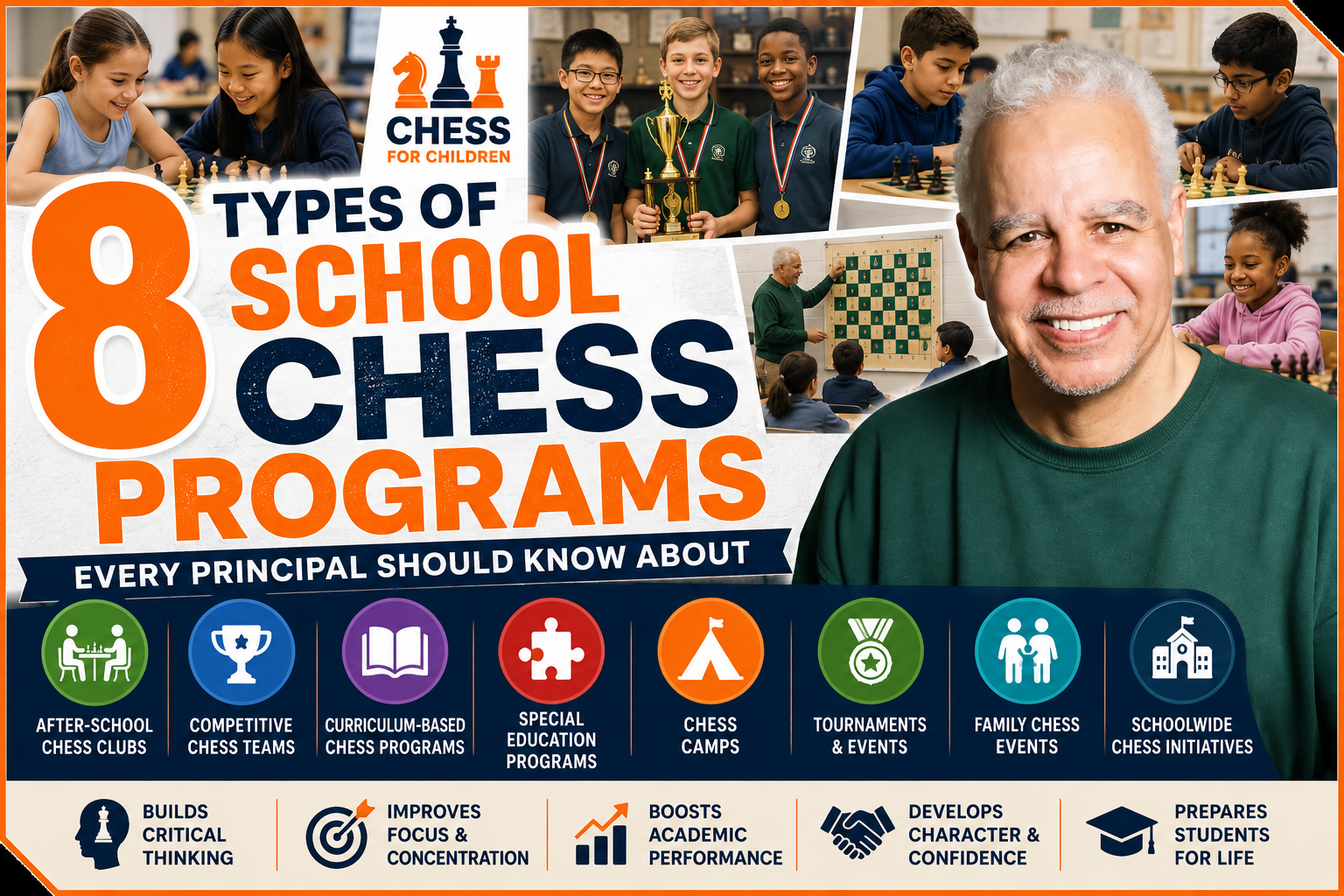
Type 1: After-School Chess Clubs
What Happens in a Chess Club?
Type 2: Competitive School Chess Teams
Type 3: Curriculum-Based Chess Programs
Curriculum-based chess programs bring chess directly into the educational day rather than offering it solely as an extracurricular activity.
In these programs, chess is used as a teaching tool to support academic learning while simultaneously developing students' thinking skills. Lessons are carefully structured and aligned with educational objectives, allowing schools to integrate chess into enrichment periods, classroom instruction, gifted programs, or special academic initiatives.
Unlike an after-school club, participation is often available to an entire grade level or class, ensuring that all students benefit from the educational value of chess.
For many schools, curriculum-based chess programs represent the most comprehensive approach to chess education.
What Happens in a Curriculum-Based Chess Program?
Students learn chess through a structured sequence of lessons designed to build both chess knowledge and critical thinking skills.
Lessons may include:
- Rules of chess
- Piece movement
- Basic checkmates
- Tactical patterns
- Planning and strategy
- Decision making
- Problem solving
- Sportsmanship and character development
Students are encouraged to think through problems, evaluate alternatives, and justify their decisions.
These skills often transfer directly to classroom learning.
Educational Benefits
Research and classroom experience suggest that chess can help students develop a wide range of academic and personal skills.
Critical Thinking
Chess teaches students to analyze situations, compare options, and make informed decisions.
Concentration
Successful chess players learn to focus for extended periods while ignoring distractions.
Problem Solving
Every chess position presents a unique challenge that requires creative thinking and logical analysis.
Patience
Students learn that careful thinking often produces better results than impulsive decisions.
Responsibility
Chess teaches students to accept responsibility for their choices and learn from mistakes.
Perseverance
Students discover that improvement comes through effort, practice, and determination.
The Importance of a Structured Curriculum
One of the biggest mistakes schools make is assuming that simply placing students in front of chessboards is enough.
Effective curriculum-based programs require:
- Clear learning objectives
- Age-appropriate lessons
- Sequential skill development
- Regular assessment
- Qualified instructors
A structured curriculum ensures that students build skills systematically rather than learning random concepts without a clear progression.
At Chess for Children, every lesson is designed to build upon previous knowledge while keeping students actively engaged.
Challenges Schools Should Consider
Curriculum-based programs typically require more planning than after-school clubs.
Schools may need to consider:
- Scheduling during the school day
- Classroom space
- Grade-level implementation
- Teacher coordination
- Program objectives
However, schools that successfully implement curriculum-based chess programs often find that the educational benefits justify the additional planning.
Is a Curriculum-Based Chess Program Right for Your School?
Curriculum-based chess programs are an excellent choice for schools that:
- Value critical thinking instruction
- Want schoolwide enrichment opportunities
- Seek innovative educational programs
- Support academic skill development
- Want all students to benefit from chess
For schools looking to maximize the educational impact of chess, a curriculum-based approach often provides the greatest long-term benefits.
Over my forty-plus years teaching children, I have seen chess help students develop not only stronger chess skills but also greater confidence, patience, focus, and problem-solving ability. These are qualities that serve students far beyond the chessboard and throughout their lives.
Type 4: Special Education Chess Programs
Special education chess programs are among the most rewarding and impactful forms of chess instruction.
Over the years, I have had the privilege of working with many students who faced a variety of learning, behavioral, social, and developmental challenges. Again and again, I have witnessed how chess can provide these students with opportunities to succeed, build confidence, and develop important life skills.
While chess is not a cure or treatment for any disability, it can be an effective educational tool when taught thoughtfully and adapted to the needs of individual learners.
Many students who struggle in traditional academic settings discover that the chessboard provides a place where they can think, learn, and achieve success at their own pace.
Why Chess Works Well in Special Education Settings
Chess provides a structured environment with clear rules, predictable outcomes, and immediate feedback.
Many students thrive when learning takes place within a framework that is organized and consistent.
The chessboard never changes.
The rules remain the same.
Students know exactly what is expected of them.
This consistency often creates a comfortable learning environment that reduces anxiety and promotes engagement.
Skills Developed Through Chess
Focus and Attention
Chess encourages students to concentrate on a single task for extended periods.
Students learn to observe carefully, think before acting, and remain engaged in the activity.
Executive Functioning
Every move requires planning, organization, and decision making.
Students learn to:
- Evaluate options
- Consider consequences
- Develop plans
- Monitor progress
- Adjust strategies
These executive functioning skills are valuable both inside and outside the classroom.
Self-Control
One of the most important lessons in chess is learning to slow down and think before acting.
Students quickly discover that impulsive decisions often lead to mistakes.
Over time, many students become more thoughtful and deliberate in their decision making.
Problem Solving
Every chess game presents a series of challenges.
Students learn how to:
- Analyze situations
- Identify problems
- Explore solutions
- Test ideas
- Learn from mistakes
These are essential skills for lifelong learning.
Confidence
Success in chess is often measurable and visible.
Students can see themselves improving.
They solve puzzles that once seemed impossible.
They win games they once would have lost.
These experiences help build confidence and self-esteem.
Social Benefits
Many students in special education programs benefit from the social opportunities chess provides.
Chess creates natural opportunities for students to:
- Take turns
- Follow rules
- Communicate respectfully
- Practice sportsmanship
- Develop friendships
Because students are focused on the game itself, social interactions often feel more comfortable and less intimidating.
The shared experience of learning chess can help build meaningful connections between students.
Adapting Chess Instruction for Diverse Learners
Effective special education chess instruction requires flexibility.
Great instructors understand that every student learns differently.
Some students benefit from:
- Visual demonstrations
- Hands-on learning
- Repetition and practice
- Smaller instructional steps
- Individualized support
- Positive reinforcement
The goal is not to force students into a single teaching method but rather to adapt instruction to meet students where they are.
As a teacher, I have always believed that if a student does not understand something, my first question should be, "How can I explain it differently?"
Benefits for Schools
Schools that implement special education chess programs often observe improvements in:
✅ Student engagement
✅ Attention and focus
✅ Classroom participation
✅ Confidence and self-esteem
✅ Social interaction
✅ Problem-solving skills
✅ Emotional regulation
While every student is unique, many schools report that chess becomes one of the activities students look forward to most.
Challenges and Considerations
Special education chess programs require instructors who understand both chess and child development.
Success depends on:
- Patience
- Flexibility
- Appropriate pacing
- Positive reinforcement
- Individualized instruction
The strongest programs focus on growth and participation rather than competition alone.
For many students, the greatest victory is not winning a game but developing the confidence to sit down and play.
Is a Special Education Chess Program Right for Your School?
A special education chess program may be an excellent choice for schools that:
- Serve diverse learners
- Support social-emotional development
- Value executive functioning skills
- Seek engaging enrichment opportunities
- Want inclusive educational experiences
When taught with care and understanding, chess can become much more than a game.
It can become a powerful tool for helping students discover their strengths, build confidence, and experience success.
Over the years, some of my proudest moments as a chess teacher have not involved trophies or championships. They have involved watching a student who once doubted themselves realize that they were capable of accomplishing far more than they ever imagined.
Type 5: Chess Camps
Chess camps provide students with an immersive learning experience that goes far beyond what is typically possible in a weekly chess club or classroom program.
Whether held during the summer, school vacations, holidays, or special enrichment periods, chess camps allow students to spend concentrated time developing their skills while enjoying a fun and engaging environment.
For many students, a chess camp becomes one of the highlights of their year.
The combination of learning, competition, social interaction, and recreational activities creates an experience that students remember long after the camp has ended.
What Happens at a Chess Camp?
Unlike traditional chess clubs that may meet once or twice per week, chess camps provide several hours of instruction and activity each day.
A typical chess camp may include:
- Chess lessons
- Tactical puzzles
- Practice games
- Team competitions
- Simultaneous exhibitions
- Tournament play
- Strategy workshops
- Chess variants and fun activities
- Awards and recognition programs
Because students spend more time engaged with chess, they often make rapid improvements in their skills.
Many students achieve more growth during a one-week chess camp than they would during several months of regular club meetings.
Benefits of Chess Camps
Accelerated Learning
The concentrated nature of camp instruction allows students to build upon concepts quickly.
Lessons that might be spread over several months in a traditional program can often be covered within a single week.
Increased Engagement
Chess camps create an exciting atmosphere where students are surrounded by other children who share similar interests.
This environment often increases motivation and enthusiasm for learning.
Confidence Building
Students have opportunities to apply new skills immediately through games, puzzles, and competitions.
Successes throughout the week help build confidence and encourage continued improvement.
Social Development
One of the greatest benefits of chess camps is the opportunity to meet new friends.
Students interact with peers from different schools, neighborhoods, and backgrounds while sharing a common interest in chess.
Many lifelong friendships begin at chess camps.
Tournament Experience
Many camps include organized tournaments that allow students to practice competing in a supportive environment.
Students learn valuable lessons about preparation, focus, sportsmanship, and resilience.
Types of Chess Camps
Summer Chess Camps
Summer camps are the most common type of chess camp.
These programs help students remain mentally active during school vacations while providing a fun and productive experience.
Holiday Chess Camps
Programs held during winter, spring, and other school breaks offer families educational options when school is not in session.
Beginner Chess Camps
These camps focus on introducing new players to the game in a friendly and supportive environment.
Advanced Chess Camps
Designed for experienced players, advanced camps often emphasize tournament preparation, strategy, tactics, and game analysis.
Specialty Chess Camps
Some camps combine chess with:
- STEM activities
- Robotics
- Art
- Sports
- Coding
- Leadership development
These hybrid programs can appeal to a wider range of students and families.
What Makes a Great Chess Camp?
The most successful chess camps combine education with excitement.
A great camp should provide:
✅ High-quality instruction
✅ Age-appropriate activities
✅ Opportunities for play
✅ Structured learning
✅ Positive social interaction
✅ A balance between challenge and fun
Students should leave camp feeling excited about chess and eager to continue learning.
In my experience, children learn best when they are having fun.
The goal is not simply to teach chess concepts but to create an environment where students become enthusiastic learners.
Challenges Schools Should Consider
While chess camps offer tremendous benefits, they do require planning and resources.
Schools and organizations should consider:
- Instructor qualifications
- Facility availability
- Scheduling
- Student supervision
- Equipment needs
- Enrollment goals
A well-organized camp requires careful preparation, but the rewards can be substantial for both students and schools.
Is a Chess Camp Right for Your School or Organization?
A chess camp may be an excellent choice if your school or organization wants to:
- Offer summer enrichment
- Provide vacation programming
- Support advanced chess students
- Introduce new students to chess
- Create engaging educational experiences
Many schools use camps as a way to introduce chess to students who may later join after-school clubs, competitive teams, or curriculum-based programs.
In this way, chess camps often serve as a gateway to broader chess participation.
A Personal Perspective
Some of my favorite teaching memories have come from chess camps.
There is something special about watching students spend an entire week immersed in learning, friendship, and discovery.
By the end of camp, students who arrived as strangers often leave as friends. Players who began the week unsure of themselves leave with new skills and greater confidence.
That transformation is one of the reasons chess camps continue to be such a valuable part of scholastic chess programs around the world.
Type 6: Chess Tournaments and Events
Chess tournaments and special events are often the most visible and exciting components of a school chess program.
While lessons and club meetings provide the foundation for learning, tournaments give students an opportunity to apply their skills in a real-world setting. They create goals, generate excitement, and provide students with experiences that often become lasting memories.
For many children, participating in their first chess tournament is a milestone similar to playing in a first sports game, performing in a school concert, or competing in a science fair.
It is a chance to test themselves, represent their school, and discover what they are capable of achieving.
Why Tournaments Matter
A chess tournament gives students something important that regular lessons cannot provide: a meaningful challenge.
When students know they will be competing against players from other schools, they often become more motivated to learn and improve.
Tournaments encourage students to:
- Practice regularly
- Set goals
- Develop discipline
- Manage pressure
- Learn from mistakes
- Celebrate improvement
Most importantly, tournaments teach students that success comes through preparation and effort.
Types of School Chess Events
In-School Tournaments
These events are conducted entirely within the school.
Students compete against classmates in a structured environment that is familiar and comfortable.
Benefits include:
✅ Easy to organize
✅ Low cost
✅ Excellent for beginners
✅ Builds excitement within the school
Inter-School Matches
Schools compete against neighboring schools or local rivals.
These matches create school spirit and give students the experience of representing their community.
Regional and State Championships
Students compete against players from a wider geographic area.
These events often attract stronger competition and provide valuable learning opportunities.
National Championships
National events bring together top scholastic players from across the country.
For many students, participating in a national championship becomes one of the highlights of their chess journey.
Family and Community Events
Schools can also host family tournaments, teacher-versus-student matches, community chess festivals, and fundraising events.
These activities help strengthen relationships among students, families, and school staff.
Educational Benefits of Tournament Play
Goal Setting
Students learn to work toward specific objectives.
Whether the goal is winning a game, earning a trophy, or simply improving performance, tournaments provide clear benchmarks for progress.
Resilience
Every player experiences losses.
Chess teaches students how to handle disappointment, learn from mistakes, and continue improving.
This lesson extends far beyond the chessboard.
Sportsmanship
Students learn to:
- Respect opponents
- Follow rules
- Win gracefully
- Lose with dignity
These character traits are valuable throughout life.
Decision Making Under Pressure
Tournament games require students to think carefully while managing time constraints and competitive pressure.
This develops confidence and independence.
Building School Pride
One of the most overlooked benefits of chess tournaments is the sense of school pride they create.
Students wear school shirts.
Parents cheer from the sidelines.
Teachers celebrate achievements.
Administrators recognize student accomplishments.
The entire school community becomes invested in the success of the program.
A strong chess team can become a source of pride just like an athletic team, debate team, or performing arts group.
The Role of the Coach
A great coach does far more than teach chess moves.
The coach helps students:
- Prepare effectively
- Set realistic goals
- Manage emotions
- Learn from setbacks
- Develop confidence
Over the years, I have coached students who went on to win city, state, and national championships.
However, the moments I remember most are often not the trophies.
They are the moments when a student discovers that hard work can lead to success.
The confidence gained from that realization often stays with them long after the tournament ends.
Challenges Schools Should Consider
Successful tournament programs require planning and support.
Schools should consider:
- Entry fees
- Transportation
- Parent volunteers
- Coaching resources
- Tournament schedules
- Equipment requirements
Fortunately, many tournaments offer opportunities for schools to participate at a variety of commitment levels.
Schools can begin with local events and gradually expand their participation as the program grows.
Is a Tournament Program Right for Your School?
Tournament participation may be an excellent option for schools that:
- Have an established chess club
- Want to motivate students
- Seek academic competition opportunities
- Wish to build school pride
- Want students to experience goal-oriented learning
Many schools find that tournaments become the driving force behind student enthusiasm and long-term participation.
When students return from an event excited about what they learned and eager to improve, the entire chess program benefits.
More Than Winning
While trophies and medals are exciting, the true value of tournaments goes much deeper.
Students learn perseverance.
They learn responsibility.
They learn how to prepare for challenges.
Most importantly, they learn that success is not determined by a single result but by the effort they put into becoming better than they were yesterday.
Those lessons remain valuable long after the final game has been played.
Type 7: Family Chess Events
Family chess events are one of the most effective ways to strengthen the connection between students, parents, teachers, and the school community.
While many educational activities focus solely on students, family chess events create opportunities for everyone to participate together. These programs transform chess from an individual activity into a shared experience that brings families and schools closer together.
Over the years, I have found that some of the most memorable moments in scholastic chess occur when parents sit down across the board from their children and discover just how much they have learned.
What Are Family Chess Events?
Family chess events are special programs designed to encourage participation from students and their families.
These events may include:
- Parent-child tournaments
- Family chess nights
- Teacher-versus-student matches
- Simultaneous exhibitions
- Chess festivals
- Community chess celebrations
- Beginner workshops for parents
- Schoolwide chess challenges
The emphasis is not solely on competition but on participation, learning, and building relationships.
Why Family Involvement Matters
Research consistently shows that students perform better when families are actively involved in their education.
Chess provides a unique opportunity for that involvement.
Unlike many academic subjects, chess is easy for parents to learn alongside their children.
Parents do not need advanced chess knowledge to participate. In fact, many family events are most successful when parents are complete beginners.
Students often enjoy becoming the teacher and showing their parents what they have learned.
This role reversal can be both empowering and confidence-building.
Benefits for Students
Increased Confidence
Few experiences are more rewarding for a child than demonstrating newly acquired skills to a parent.
When students teach a parent how the pieces move or explain a strategy, they gain confidence in their own abilities.
Greater Motivation
Students are often more enthusiastic about practicing when they know family members are interested in their progress.
Family participation helps reinforce the value of learning.
Improved Communication
Chess creates natural opportunities for conversation and interaction between parents and children.
Families often continue discussing games, puzzles, and strategies long after the event has ended.
Positive Memories
Many students remember family chess nights for years.
The shared experience creates lasting memories that strengthen family bonds.
Benefits for Schools
Family chess events also provide significant advantages for schools.
Stronger School Community
These events bring together students, parents, teachers, administrators, and staff in a positive and enjoyable setting.
The result is a greater sense of community and school spirit.
Increased Parent Engagement
Many schools struggle to encourage meaningful parent participation.
Chess events provide an enjoyable reason for families to visit the school and become involved.
Positive School Culture
Family events help create an environment where learning is celebrated and academic achievement is valued.
Program Visibility
Family events also showcase the school's chess program and often attract new participants.
Parents who attend frequently become strong supporters of the program.
Popular Family Chess Event Ideas
Parent-Child Tournament
Students partner with their parents and compete as teams.
These events are always popular because they encourage cooperation and shared learning.
Family Chess Night
Families rotate through chess stations featuring puzzles, mini-games, lessons, and friendly competition.
Teachers vs. Students Match
Students love the opportunity to challenge their teachers at the chessboard.
This event often generates tremendous excitement.
Simultaneous Exhibition
An experienced chess instructor or strong player competes against multiple participants at the same time.
These exhibitions are both educational and entertaining.
Community Chess Festival
Schools can combine chess activities with refreshments, awards, demonstrations, and family-friendly entertainment.
What Makes Family Chess Events Successful?
The best family events focus on participation rather than performance.
Successful events are:
✅ Inclusive
✅ Welcoming to beginners
✅ Well organized
✅ Fun and engaging
✅ Focused on community building
Parents should never feel intimidated because they do not know how to play chess.
The goal is to create an atmosphere where everyone feels comfortable participating.
Challenges Schools Should Consider
As with any event, planning is important.
Schools should consider:
- Scheduling
- Space requirements
- Equipment needs
- Volunteer support
- Promotion and communication
- Event structure
Fortunately, most family chess events can be organized with relatively modest resources.
The benefits often far exceed the effort required.
Is a Family Chess Event Right for Your School?
Family chess events are an excellent choice for schools that want to:
- Increase parent engagement
- Strengthen school culture
- Build community connections
- Showcase student achievement
- Promote educational enrichment
Even a single family chess night can create enthusiasm that lasts throughout the school year.
A Personal Perspective
Some of my favorite moments as a chess teacher have occurred during family chess events.
I have watched parents who never played chess learn the game alongside their children. I have seen students proudly teach concepts they had recently mastered. I have witnessed entire families discover a shared activity that brought them closer together.
Those moments remind us that chess is about more than pieces and moves.
At its best, chess becomes a bridge between people—a way to learn, communicate, and grow together.
When schools create opportunities for families to participate, everyone benefits.
Type 8: Schoolwide Chess Initiatives
Schoolwide chess initiatives represent the most comprehensive approach to chess education.
Rather than serving only a small group of interested students, these programs seek to make chess an integral part of the school's culture. The goal is to create an environment where chess becomes a shared educational experience that benefits students, teachers, families, and the broader school community.
When implemented successfully, a schoolwide chess initiative transforms chess from an extracurricular activity into a powerful educational tool that supports the school's academic and social-emotional goals.
What Is a Schoolwide Chess Initiative?
A schoolwide chess initiative goes beyond after-school clubs, tournaments, and individual classes.
Instead, chess becomes woven into multiple aspects of school life.
A schoolwide initiative may include:
- Classroom chess instruction
- After-school chess clubs
- Competitive chess teams
- Family chess events
- School tournaments
- Teacher training
- Chess enrichment activities
- Chess-themed assemblies and celebrations
The objective is to create multiple opportunities for students to engage with chess throughout their educational experience.
Why Schools Choose Schoolwide Chess Initiatives
Many schools recognize that chess teaches far more than how to move pieces on a board.
Chess develops skills that support success in both academics and life.
These include:
Critical Thinking
Students learn to analyze situations, evaluate alternatives, and make informed decisions.
Problem Solving
Chess encourages students to identify challenges and develop solutions.
Concentration
Students practice focusing their attention and avoiding distractions.
Perseverance
Improvement in chess requires patience, effort, and resilience.
Responsibility
Students learn that their decisions have consequences and that success often depends upon thoughtful planning.
Sportsmanship
Chess teaches respect, fairness, and gracious behavior in both victory and defeat.
Building a Chess Culture
One of the most exciting aspects of a schoolwide initiative is the creation of a genuine chess culture.
In schools with strong chess cultures, you may see:
- Students playing chess during lunch
- Chess sets available in classrooms
- School chess champions recognized at assemblies
- Family chess nights throughout the year
- Teachers incorporating chess concepts into lessons
- Students teaching younger children how to play
Over time, chess becomes part of the school's identity.
Students begin to view chess not simply as a game but as an opportunity for learning and growth.
Schoolwide Benefits
Schools that embrace chess across multiple programs often experience benefits that extend far beyond the chessboard.
Increased Student Engagement
Many students who may not participate in traditional athletics or activities find a sense of belonging through chess.
Positive School Climate
Chess encourages respectful interaction, thoughtful behavior, and healthy competition.
Expanded Enrichment Opportunities
A schoolwide initiative provides meaningful learning experiences for students at all ability levels.
Stronger Community Connections
Parents, teachers, administrators, and students all become stakeholders in the program's success.
Long-Term Sustainability
Programs that are integrated into school culture are more likely to thrive year after year.
A Roadmap for Building a Schoolwide Chess Initiative
Most schools do not start with a fully developed chess initiative.
Instead, successful programs typically grow over time.
A common progression looks like this:
Step 1: Start an After-School Chess Club
Introduce students to chess in a fun and welcoming environment.
Step 2: Develop a Competitive Team
Provide opportunities for students to participate in tournaments and represent the school.
Step 3: Add Family Events
Engage parents and strengthen community support.
Step 4: Expand Classroom Opportunities
Introduce curriculum-based instruction and enrichment activities.
Step 5: Establish School Traditions
Create annual tournaments, celebrations, awards programs, and special events.
Over time, chess becomes an established and valued part of the school's educational experience.
Challenges Schools Should Consider
Schoolwide initiatives require commitment and planning.
Schools should consider:
- Administrative support
- Staffing
- Scheduling
- Training
- Equipment
- Long-term goals
However, schools do not need to implement everything at once.
Many successful initiatives begin with a single club and gradually expand over several years.
Is a Schoolwide Chess Initiative Right for Your School?
A schoolwide initiative may be an excellent choice for schools that:
✅ Value critical thinking and problem solving
✅ Want meaningful enrichment opportunities
✅ Seek to strengthen school culture
✅ Encourage family engagement
✅ Support academic and social-emotional growth
✅ Want a program that can benefit students across multiple grade levels
When thoughtfully implemented, chess can become one of the most impactful enrichment programs a school offers.
Final Thoughts
After more than forty years of teaching children, I have seen chess change lives.
I have watched shy students gain confidence. I have watched struggling learners discover their strengths. I have seen friendships formed, families brought together, and students achieve goals they once thought impossible.
While not every child will become a champion chess player, every child can benefit from the lessons chess teaches.
That is why schools continue to invest in chess programs.
Whether through after-school clubs, competitive teams, curriculum-based instruction, special education programs, camps, tournaments, family events, or schoolwide initiatives, chess offers schools a unique opportunity to help students develop skills that will serve them for a lifetime.
Ready to Bring Chess to Your School?
Chess for Children has been helping schools build successful chess programs for more than 40 years.
From after-school clubs and competitive teams to curriculum-based instruction and schoolwide initiatives, we can help design a program that meets the unique needs of your students and community.
National Master Stephen Colding has taught thousands of children and coached numerous city, state, and national champions.
📞 631-278-1677
📧 Contact Chess for Children
🌐 ChessForChildren.com
Let's work together to build a chess program that inspires your students, strengthens your school community, and helps children develop skills that last a lifetime.