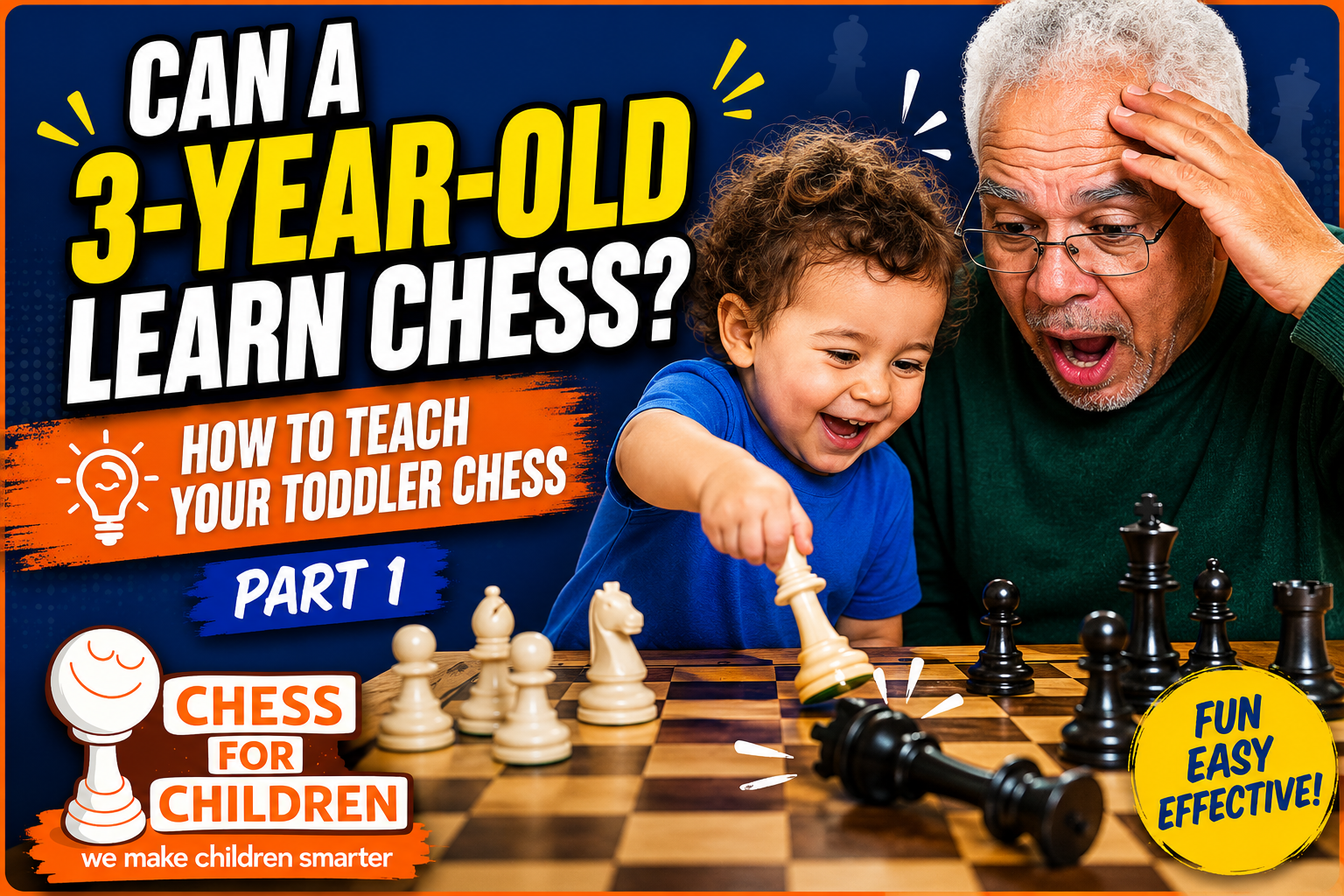
Can a 3-year-old learn chess?
After teaching thousands of children over more than fifty years, I can tell you that the answer is yes—but probably not in the way most parents imagine.
Many parents picture a young child sitting quietly for an hour, learning openings and solving chess puzzles.
That's not how toddlers learn.
The real secret is understanding how young children think, play, and explore the world around them.
In this article, I'll explain when children are ready for chess, the benefits of starting early, and the first steps parents can take to introduce the game successfully.
One of the most common questions I hear is:
"What is the best age for a child to learn chess?"
The answer depends on the child.
Some children are ready to begin learning simple chess concepts at age three or four.
Others may not be ready until five or six.
The key isn't age.
The key is attention span.
A child who can:
Follow simple directions
Sit for 5–10 minutes
Recognize shapes and patterns
Enjoy learning games
is often ready to begin learning chess.
Many parents try to teach all the rules at once.
This almost always fails.
Young children learn best through stories, games, repetition, and play.
When I teach toddlers, I don't begin by explaining every rule.
Instead,
I focus on helping them:
Recognize the chess pieces
Learn the names of the pieces
Understand that each piece moves differently
Have fun
The goal is not to create a tournament player overnight.
The goal is to create enthusiasm.
Research and experience both suggest that chess can help children develop:
Concentration
Children learn to focus their attention and think before acting.
Problem-Solving Skills
Every move presents a new challenge.
Pattern Recognition
Chess teaches children to recognize recurring ideas and structures.
Confidence
Few things are more exciting than solving a problem on your own.
Patience
Children quickly learn that good decisions often require careful thought.
These skills help children both on and off the chessboard.
During my career, I have taught children as young as two years old.
The children who succeed are not necessarily the smartest.
They are usually the children who are having the most fun.
When learning becomes enjoyable, improvement follows naturally.
This is why I always encourage parents to make chess a positive experience rather than a forced activity.
No.
And that's okay.
Every child develops at a different pace.
T
he important question is not:
"Can my child become a chess champion?"
The important question is:
"Can my child enjoy learning something new?"
If the answer is yes, chess can be a wonderful activity to explore together.
Large text.
Before children learn strategy, tactics, or checkmate, they must become familiar with the pieces.
Start by introducing:
The King
The Queen
The Rook
The Bishop
The Knight
The Pawn
Don't worry about perfect understanding.
At this stage, recognition and familiarity are enough.
In Part 2 of this series, we'll explore the first chess pieces children should learn and how to teach movement using fun activities that toddlers enjoy.
Whether you're a parent, grandparent, teacher, or homeschooler, chess can be one of the most rewarding educational activities you share with a child.
Get:
Chess tips for parents
Free puzzles
Learning activities
New videos
and lessons
Join Here → [Newsletter Link]
Private Lessons
School Chess Programs
Jess's Chess Adventure