What Is the Best Age to Start Chess? After 40 Years of Teaching Children, Here's What I've Learned
by National Master Stephen Colding
One of the questions parents ask me most often is: Mr. C, what is the best age for my child to start chess?"
After teaching children for more than forty years, my answer is always the same:
Age is not the most important factor.
Involvement is. I've taught children in pre-kindergarten. I've taught children who could barely write their names. In fact, I have taught children to write chess notation before they could properly write all of their letters.
The question isn't: "How old is the child?" The question is: "Is the child interested?" "Is the child engaged?"
If the answer is yes, then they may be ready to begin.
Children Don't Know They Are Supposed To Fail
One thing I learned early in my teaching career is that children and adults think very differently. Adults worry about failure. Children usually don't. A young child doesn't sit down at a chessboard wondering if they are going to look foolish. They don't worry about ratings. They don't worry about titles. They don't worry about what other people think. Many children simply enjoy learning. Unfortunately, adults sometimes teach them to be afraid.
At Chess for Children, we try very hard not to do that. We make chess feel like a game. We make learning feel like an adventure.
For very young children, we remove much of the emphasis from winning and losing. Instead, we focus on learning and mastering skills.
Confidence Comes Before Success
In my experience, confidence is one of the most important ingredients in learning. Children who believe they can learn usually do. Children who become afraid of making mistakes often stop trying. That is why I spend a great deal of time building confidence. Sometimes a very young child desperately wants to win.
Usually it's the boys. If that child has genuinely understood the lesson, I may occasionally allow them to win.
Not because winning is important. Because confidence is important. The victory is not the reward.
The understanding is the reward. The win simply reinforces the lesson. The child leaves feeling successful and excited to learn more. That confidence becomes fuel for future growth.
Winning Is Not The Goal
For very young children, winning should not be the primary goal. Mastering skills should be. Can they identify a check? Can they protect a piece? Can they remember how the knight moves? Can they spot a simple fork?
Can they follow the lesson? Those are the victories that matter. Tournament wins can come later.
Too many coaches focus on results. I focus on development. If the development is correct, the results usually take care of themselves.
What Happens Around Age Five Or Six?
As children get older, competition begins to play a larger role. Around five or six years old, children start understanding winning and losing differently. At that point, they need opportunities to compete honestly.
Not because winning is everything. But because learning how to handle victory and defeat is one of life's important lessons. Sooner or later every chess player loses. The question isn't whether they will lose.
The question is: How will they respond? Will they quit? Will they make excuses? Or will they learn?
Everyone Loses At Chess
One of the most important lessons I teach my students is this:
Everyone loses at chess.
Beginners lose. National champions lose. Grandmasters lose. World champions lose.
Even computers lose. Today there are chess engines capable of analyzing billions of positions.
And even they lose games. So losing is not evidence of failure. Losing is evidence that you are challenging yourself. When one of my students loses a game, I often tell them: "If we win, we win." If we lose, we still win because we learned something." The only real loss is refusing to learn.
Why Losing Is Necessary
Imagine winning every game you ever played. At first that might sound wonderful. But after a while it would become incredibly boring. You would already know everything. There would be no challenge. There would be no growth. There would be no reason to continue. Chess is fascinating because there is always another lesson waiting around the corner. Every mistake teaches us something. Every defeat reveals a weakness we can improve. Every difficult game makes us stronger. That is why losing is not the enemy. Stopping the learning process is.
Can Children With ADHD Or Autism Learn Chess?
Over the years I have taught many children who had been diagnosed with ADHD, autism, or other learning differences. This is not to say that these conditions are not real. They are.
What I have learned, however, is that a diagnosis does not tell me how much a child can achieve.
What matters is making a connection with the student. Some children need movement. Some need repetition.
Some need visual examples. Some need extra patience. My responsibility as a teacher is to find the path that works for that child. I have watched children who struggled in traditional classroom environments become highly successful chess players. I have watched children surprise their parents, their teachers, and sometimes even themselves. One remarkable example is International Master Justin Sarkar, who was diagnosed as being on the autism spectrum and went on to achieve an international chess title. His story reminds us that potential cannot be measured by labels. At the highest levels of chess, success comes from the same qualities for everyone: Hard work. Calculation. Persistence. Resilience. Grit. Those qualities matter far more than any diagnosis.
Never Underestimate A Child
Many years ago I attended the Foxwoods Open and spent some time walking around the tournament hall watching games. One game caught my attention immediately.
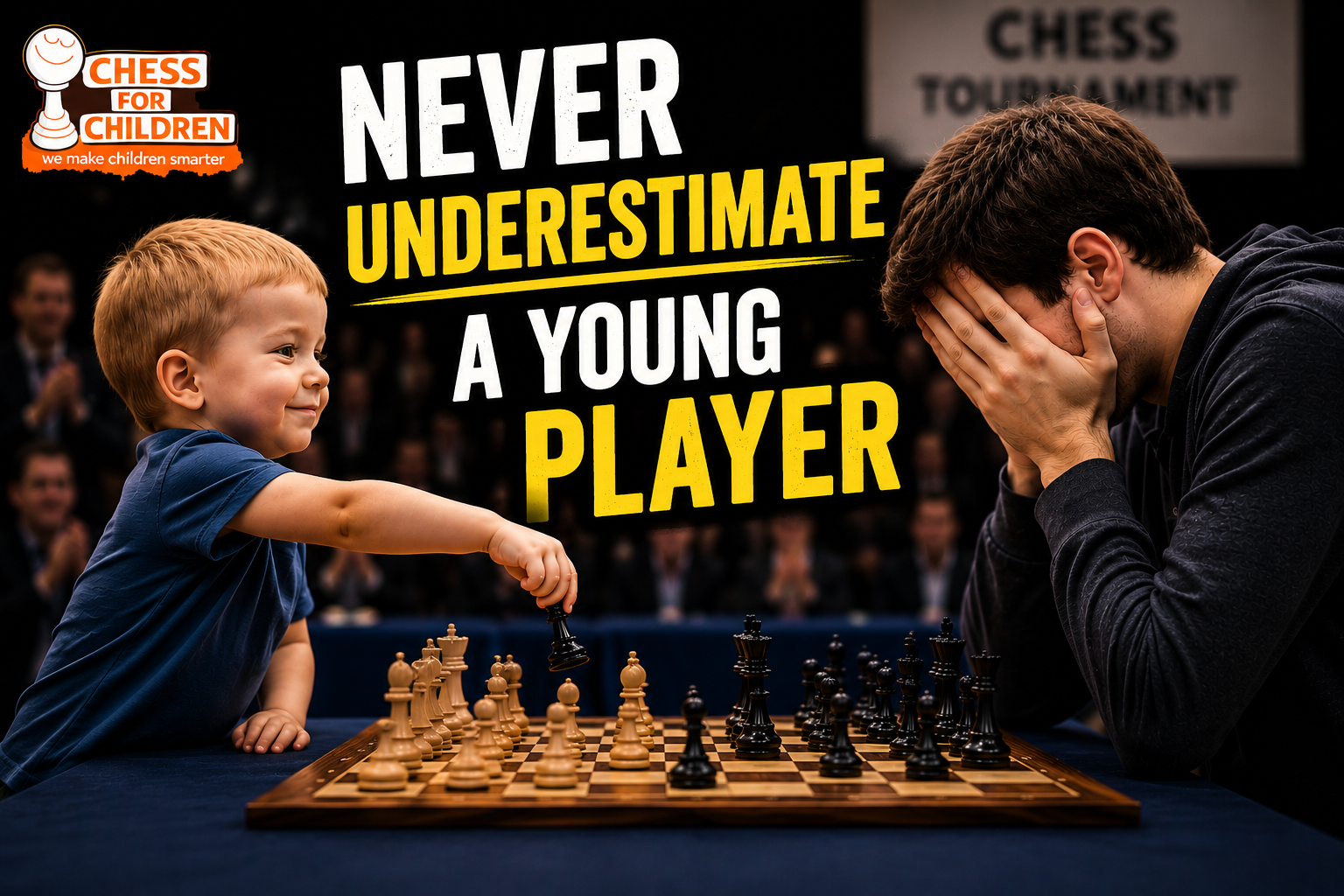
A very young child was playing an adult who looked to be in his twenties. The contrast was striking.
The child was so small that he couldn't comfortably reach the chessboard. Two telephone books had been placed on the chair so he could sit high enough to play. His opponent was a tall young man, probably six foot two.
As I watched the game, it became obvious that the adult wasn't taking his opponent very seriously.
After all, he was just a little kid. As the game continued, something unexpected happened.
The adult began getting the worse position. You could almost see the realization spreading across his face.
Suddenly he wasn't playing a child anymore. He was playing a stronger player.
Eventually the adult reached out his hand confidently and said: "Draw?" What happened next is something I have never forgotten. The little boy slowly looked up. A cold expression came across his face. Then he slowly shook his head from side to side. No. Not a chance. The adult slumped back into his chair. A short time later the child won the game decisively. The lesson has stayed with me for years. Too many people see a child's age before they see the In chess, the board doesn't care how old you are The pieces don't care how tall you are.
The only thing that matters is the quality of your decisions.
That little boy taught everyone in the room an important lesson: Never underestimate a child.
Not Every Child Needs To Become A Champion
Of course, not every child will become a national champion. Most won't. But that doesn't mean chess has failed them. Chess teaches concentration. Chess teaches patience. Chess teaches planning. Chess teaches responsibility.
Chess teaches children how to recover from mistakes and keep moving forward. Those lessons have value whether a child becomes a grandmaster or simply becomes a more thoughtful and confident human being.
For me, success has never been measured only by trophies. Success is measured by growth.
If a child becomes more confident, more focused, and more resilient, then chess has already done something wonderful.
So What Is The Best Age To Start Chess?
The best age is not three. The best age is not five. The best age is not seven. The best age is whenever a child is ready to become involved. If they are curious, engaged, and excited to learn, they are ready. Because success in chess does not begin with age. It does not begin with talent. It does not begin with IQ. It begins with confidence. It begins with involvement. It begins with the willingness to learn from mistakes. After forty years of teaching children, I have taught future champions. I have taught children with learning differences.
I have taught children who could barely reach the board. The lesson has always been the same.
Chess is not really about creating great chess players. Chess is about helping children become stronger thinkers, better problem-solvers, and more resilient human beings. If your child is excited to learn, then they are ready. And that means today is the perfect age to start.
Ready for Your Child to Play?