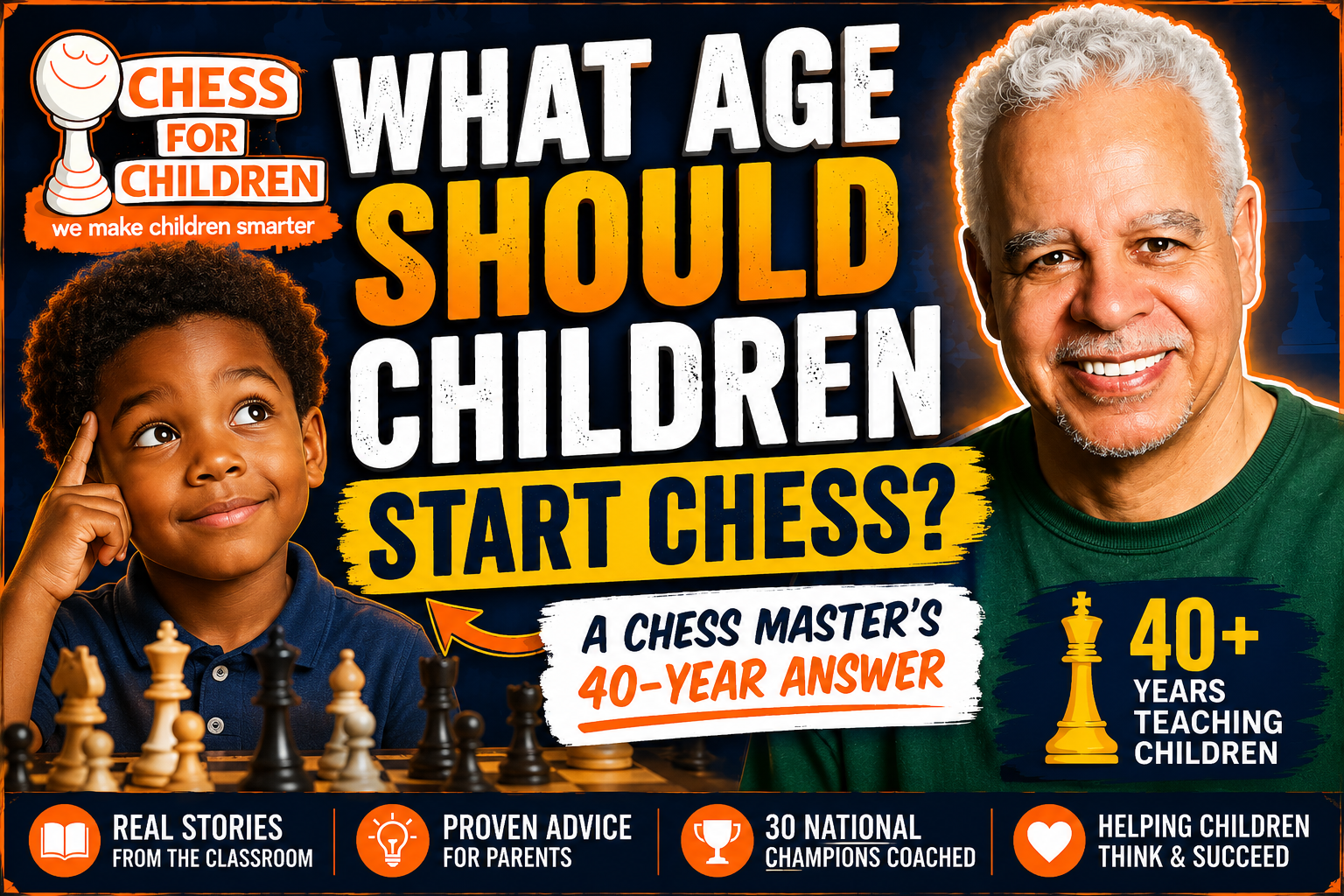
What Age Should Children Start Chess? A National Master's 40-Year Answer
Quick Answer
Most children can successfully begin learning chess between ages 4 and 6. However, some children are ready at age 3, and I have personally introduced chess concepts to children as young as 2. The key is not age—it is readiness, curiosity, attention span, and teaching style.
♟️ In This Article
Whether your child is 2, 3, 5, or 10 years old, this guide will help you understand when children are truly ready to learn chess—and what really matters for long-term success.
📚 What You'll Discover
🎯 Why Parents Worry About Starting Age
🧒 What Is the Best Age to Start Chess?
🧠 The Real Question: Is Your Child Ready?
🎨 Different Children Learn Differently
- Visual Learners
- Auditory Learners
- Kinesthetic Learners
- Social Learners
👶 The Story of the Two-Year-Old Who Asked Me to Play Chess
📖 The Telephone Book Story: What It Taught Me About Young Children
✅ Signs Your Child Is Ready to Learn Chess
🏆 Famous Chess Prodigies Who Started Young
- José Raúl Capablanca
- Samuel Reshevsky
- Anatoly Karpov
🌟 Students I've Taught Who Started Early
- Toshinori Underwood
- Maya Doron-Repa
⚠️ Common Mistakes Parents Make
💡 Why Thinking Matters More Than Winning
❓ Frequently Asked Questions About Children and Chess
♔ My 40-Year Conclusion
🎥 Before You Read Further...
After teaching thousands of children over more than 40 years, I discovered something that changed the way I teach chess:
Not all children learn the same way.
Some children learn by seeing. Some learn by hearing. Some learn by doing. Others learn best through social interaction.
In this short video, I explain the 4 major learning styles and how understanding them can dramatically improve your child's chess experience.
♟️ Watch the video below before continuing.
One of the questions I hear most often from parents is:
"What age should my child start chess?"
After more than forty years of teaching thousands of children, coaching approximately thirty national champions, teaching in schools throughout New York City, and working with children as young as two years old, my answer usually surprises people.
The best age to start chess is not necessarily the earliest age.
The best age to start chess is when a child is curious, engaged, and ready to learn.
Some children are ready at three.
Some are ready at five.
Some discover chess at eight or nine and quickly become outstanding players.
Over the years I've learned that age matters far less than most parents think.
The real question isn't:
"How old should my child be?"
The real question is:
"When is my child ready to learn how to think?"
Because that's what chess really teaches.
Not openings.
Not tactics.
Not ratings.
Chess teaches children how to think before they act.
And as I often tell parents:
Thinking beats everything.
Why Parents Worry About Starting Age
Parents naturally want to give their children every advantage.
They hear stories about child prodigies and wonder:
Am I starting too late?
Should my child have started earlier?
Is my child missing an opportunity?
These concerns are understandable.
After all, some of the greatest chess players in history began at very young ages.
Famous Chess Prodigies Started at Different Ages
José Raúl Capablanca
Future World Champion José Raúl Capablanca reportedly learned chess at age four simply by watching his father play.
Legend has it that he noticed his father make an illegal move and pointed out the mistake.
He would eventually become one of the greatest natural talents the game has ever seen.
Samuel Reshevsky
Samuel Reshevsky was one of the greatest child prodigies in chess history.
As a small child he traveled the world giving simultaneous exhibitions against adults and defeating experienced players.
His abilities amazed everyone who saw him.
Bobby Fischer
Bobby Fischer learned chess at around age six.
His fascination with the game became an obsession.
That passion eventually led him to become World Champion and one of the most famous chess players who ever lived.
Anatoly Karpov
Future World Champion Anatoly Karpov was introduced to chess at a very young age.
He would become one of the greatest positional players in chess history and eventually dominate world chess for decades.
What Do These Players Teach Us?
Notice something interesting.
Four world champions.
Four different childhoods.
Four different paths.
There was no magic age.
What they shared was curiosity, opportunity, and a love of learning.
The Two-Year-Old Who Wanted to Play Chess
One of the most memorable moments of my teaching career involved a child who wasn't even three years old.
For several weeks he quietly watched older children play chess.
He wasn't taking lessons.
He wasn't enrolled in the class.
He simply observed.
Day after day.
Week after week.
Then one afternoon he walked up to me and asked:
"Mr. C, can I play too?"
Most adults assume a two-year-old couldn't possibly understand what is happening on a chessboard.
Yet this child had been paying attention the entire time.
Children are constantly learning.
They watch.
They imitate.
They absorb information.
That experience taught me an important lesson:
Never underestimate a curious child.
Would I recommend tournament chess for a two-year-old?
Of course not.
But I learned that interest in chess can begin much earlier than most adults realize.
The Child Sitting on Two Telephone Books
Many years ago I attended the Foxwoods Open.
As I walked through the tournament hall, I noticed something unusual.
Across from a grown man sat a very young child.
The child was so small he had to sit on two telephone books just to see over the chessboard.
Like many adults, the man probably assumed he was about to have an easy game.
He wasn't.
Move after move the child played confidently.
The game continued.
Then continued some more.
Eventually, after a long struggle, the adult looked up and asked:
"Draw?"
I have never forgotten that moment.
The lesson wasn't that every young child is a chess prodigy.
The lesson was that children are often capable of far more than adults imagine.
Sometimes the greatest obstacle isn't the child.
It's the expectations of the adults around them.
The Question Isn't Age—It's How Your Child Learns
One of the biggest mistakes parents make is assuming all children learn the same way.
They don't.
After teaching thousands of students, I've discovered that learning style often matters more than age.
The Intuitive Child
Some children seem to absorb information almost magically.
They watch.
They observe.
They listen.
Then suddenly they understand.
The two-year-old I mentioned earlier was this type of learner.
For weeks he simply watched.
When he finally asked to play, he already understood much more than people expected.
These children often learn long before adults realize they are learning.
The Curious Child
This is my favorite type.
These children ask:
"Why?"
Then they ask:
"Why?"
Then they ask:
"Why?" again.
Some adults find this exhausting.
I love it.
Curiosity is one of the strongest predictors of future success in chess.
The game rewards children who ask questions and search for answers.
The Distracted Child
Many parents worry because their child seems distracted.
I have good news.
Some of the strongest players I've ever taught started out exactly this way.
Distracted children often have active minds.
The challenge isn't intelligence.
The challenge is engagement.
When lessons are fun, interactive, and age-appropriate, these children often thrive.
I've seen children who couldn't sit still for ten minutes become completely absorbed in a fascinating chess position.
The challenge isn't getting them to focus.
The challenge is giving them something worth focusing on.
The Stubborn Child
Every teacher knows this child.
You explain something.
They insist on doing it their own way.
You explain again.
They still want to experiment.
At first this can be frustrating.
But I've learned something surprising.
Many stubborn children become excellent chess players.
Why?
Because chess rewards independent thinking.
The child who challenges ideas today often becomes the player who finds original solutions tomorrow.
What 30 National Champions Taught Me
Over the years I have coached approximately thirty national champions.
People often assume they all started at the same age.
They didn't.
Some started very young.
Others started later.
What mattered wasn't simply when they started.
What mattered was curiosity, persistence, support, and good instruction.
Toshinori Underwood
One student I taught in a pre-kindergarten class was Toshinori Underwood.
Years later he became a chess master.
At the time he was simply another child learning the game.
Nobody knew exactly what he would become.
Maya Doron-Repa
Another student was Maya Doron-Repa.
I began teaching Maya when she was in kindergarten.
At the time there was no way to know she would eventually become one of the strongest young female players in America.
She became the highest-rated girl in New York for her age and at one point the second-highest-rated girl in the entire United States for her age group.
When I first met Maya, she was simply a curious child who wanted to learn.
That's one of the greatest lessons chess has taught me.
You never know which child is going to blossom.
Ages 3-4: Learning Through Play
Many children are ready to begin learning chess between ages three and four.
At this stage the goal should not be competition.
The goal should be exploration.
Children should learn:
Piece names
Piece movement
Taking turns
Following instructions
Basic problem-solving
Most importantly:
They should have fun.
If chess becomes work, children lose interest.
If chess becomes play, wonderful things happen.
Ages 5-6: The Sweet Spot
For many children, ages five and six are ideal.
Children at this stage are developing:
Better concentration
Stronger listening skills
Improved memory
Greater patience
This is often when they begin understanding planning and strategy.
Many successful scholastic players begin at this age.
Ages 7-10: You're Not Late
One of the biggest misconceptions in chess is that children must start extremely young.
This simply isn't true.
Many children who begin at seven, eight, nine, or even ten years old make rapid progress.
Often they learn faster because they can:
Read independently
Follow directions
Focus longer
Understand abstract concepts
I've seen many children start at these ages and become excellent tournament players.
Mr. C's Three-Question Readiness Test
Parents often ask how they can tell if their child is ready.
Here's my simple test.
1. Does your child ask questions?
Curious children often make excellent chess students.
2. Does your child enjoy puzzles?
Chess is really a collection of puzzles connected together.
3. Does your child want to play again?
This may be the most important question of all.
Enthusiasm beats talent every time.
If the answer is yes to all three questions, your child is probably ready.
The Biggest Mistake Parents Make
The biggest mistake I see is parents focusing too much on age.
They believe earlier is always better.
I disagree.
A child who starts at seven and loves chess will usually outperform a child who starts at four because a parent wants them to.
You cannot force curiosity.
You cannot force passion.
You can only create opportunities.
The Real Benefits of Starting Chess Early
Parents often ask whether chess makes children smarter.
After forty years of teaching, I've seen chess help children develop:
Concentration
Confidence
Patience
Critical thinking
Problem-solving skills
Better decision-making
Emotional resilience
These benefits often matter far more than trophies and ratings.
Frequently Asked Questions
Can a 2-year-old learn chess?
Some can begin learning through observation and play, although most children are not ready for formal instruction.
Can a 3-year-old learn chess?
Yes. With age-appropriate lessons and individual attention, many three-year-olds can learn the basics.
Is 7 too late to start chess?
Not even close. Many excellent players begin at seven, eight, nine, or later.
What is the best age to start chess?
For most children, ages four to six are ideal, but motivated children can start earlier.
Should I force my child to play chess?
No. Curiosity works much better than pressure.
So What Age Should Children Start Chess?
After more than forty years of teaching children, my answer remains the same.
Some children are ready at three.
Many are ready at five or six.
Others discover chess later and thrive.
There is no perfect age.
There is only the right environment.
When parents ask me what age children should start chess, I tell them they may be asking the wrong question.
The better question is:
"When is my child ready to learn how to think?"
Because chess teaches much more than openings, tactics, and endgames.
Chess teaches children how to think before they act.
And as I often tell parents:
Thinking beats everything.
Ready to Introduce Your Child to Chess?
Whether your child is three, six, or ten years old, the right instruction can make all the difference.
At Chess for Children, we specialize in helping children develop confidence, concentration, critical thinking, and problem-solving skills through fun, age-appropriate chess instruction.
Because the goal isn't simply to create better chess players.
The goal is to help children become better thinkers.
♟️ Ready to Introduce Your Child to Chess?
Whether your child is 3, 6, or 10 years old, the right instruction can make all the difference.
At Chess for Children, we help young players develop:
✅ Confidence
✅ Concentration
✅ Critical Thinking
✅ Problem-Solving Skills
✅ A Love of Learning
After more than 40 years of teaching children, one lesson stands above all others:
Thinking beats everything.
The goal isn't simply to create stronger chess players.
The goal is to help children become stronger thinkers.
Learn More
🔶 Private Chess Lessons
🔶 School Chess Programs
🔶 Online Chess Courses for Children
🔶 Chess Clubs and Tournament Training