Finding the Best Chess Coach in New York:
What Parents Should Really Look For
"40+ Years Teaching Kids"
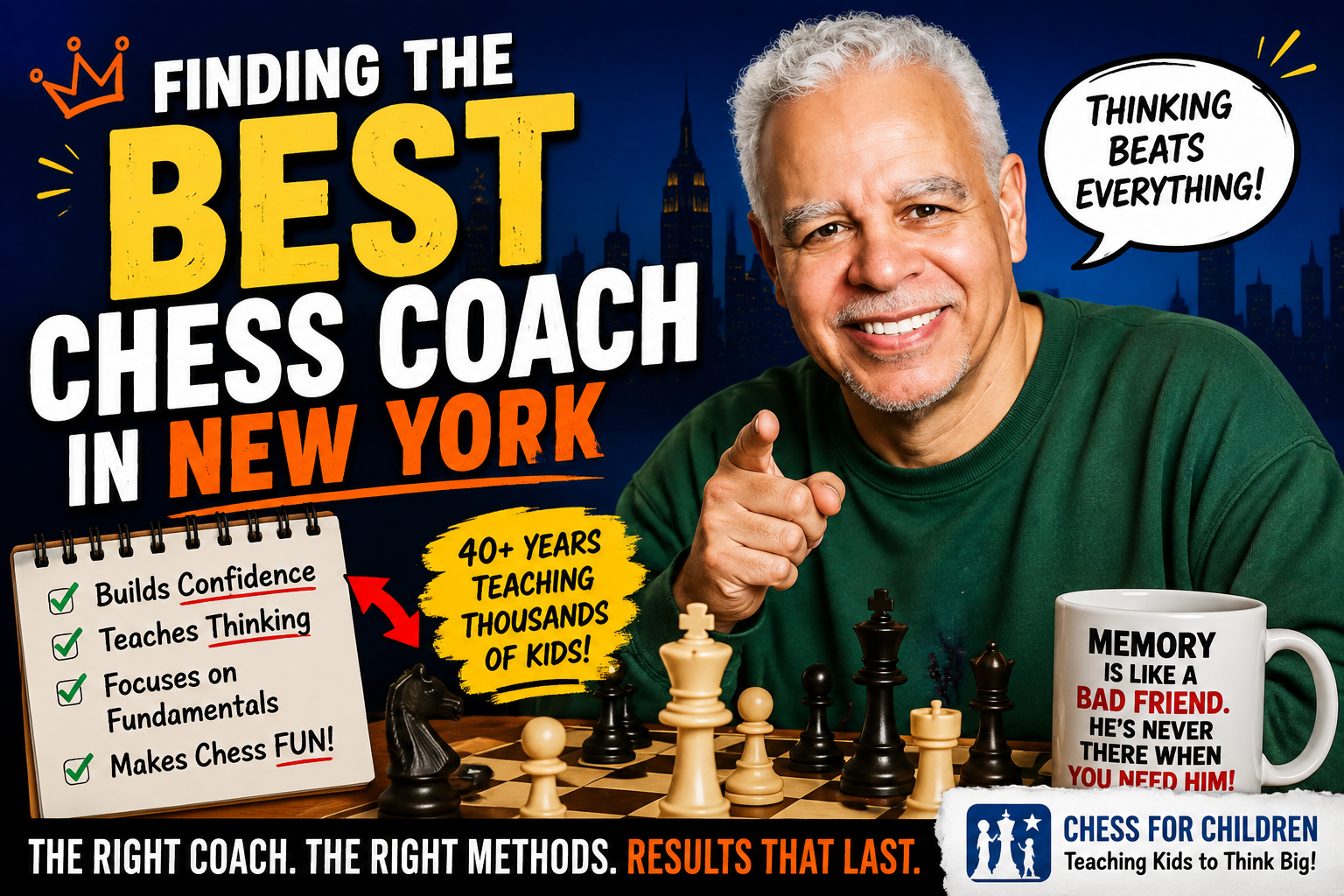
When parents begin searching for a chess coach, they often start by asking a simple question: "Who is the strongest player?" While chess strength certainly matters, after more than forty years teaching thousands of children, I have learned that the strongest player is not always the best teacher. Some of the world's strongest players struggle to explain basic concepts to beginners. On the other hand, some excellent teachers may not have the highest ratings, but they know how to help students learn, grow, and develop confidence. The truth is that the best chess coach is not someone who simply knows chess. The best chess coach understands people.
A great coach understands how children learn, how confidence is built, how habits are formed, and how to help students become independent thinkers.
1. A Great Coach Sets Goals That Build Confidence
One of the first things I do with a new student is establish goals. Not fantasy goals. Not goals based on what a parent wants. Not goals based on what the coach wants. Realistic goals.
Confidence is built one success at a time. Many coaches focus immediately on ratings, championships, and trophies. While those goals can be important, students need smaller victories along the way.
A student who learns to spot a fork. A student who finally understands opposition. A student who wins a game because they followed a plan.
Those victories matter. Every accomplishment tells the student: I can do this." The best coaches understand that confidence is not given It is earned.
2. Meet Students Where They Are, Not Where You Want Them To Be
This is one of the biggest mistakes coaches make. The coach wants to teach advanced concepts.
The student still struggles with basic checkmates. The coach teaches a complicated opening system.
The student still hangs pieces. The result is frustration. Learning happens when instruction matches the student's current level. A great coach meets students exactly where they are today and helps them take the next step forward. You cannot skip steps. Strong foundations create strong players.
3. Understand The Person, Not Just The Chess Player
Every student is different. Some students are naturally aggressive. Some are cautious. Some love tactics.
Some enjoy slow positional play. Some need encouragement. Some need accountability. Some learn visually.
Some learn through experience. The best coaches take time to understand the individual sitting across the board. The goal is not to create copies of the coach.
The goal is to help students become the strongest version of themselves.
4. Consider Work Ethic
Talent matters. Work ethic matters more. One of the first questions a coach should ask is: "How much work is this student willing to do?" A student who practices ten minutes a day needs a different plan than a student preparing for national competition. Good coaching aligns expectations with effort. The strongest improvements usually come from students who are willing to work between lessons. There is no substitute for practice.
5. Chess Must Be Fun
This may be the most overlooked quality of all. Chess should be enjoyable. Children learn best when they are engaged, excited, and curious. A lesson that feels like a punishment will never produce great results.
A lesson that feels like an adventure often will. The best coaches know how to challenge students while keeping them motivated. They celebrate progress. They create enthusiasm. They make students want to come back for the next lesson. After forty years of teaching, I have found that students who enjoy learning improve far faster than students who feel pressured. Fun is not the enemy of learning. Fun is often the engine that drives learning.
6. A Coach Must Take Responsibility
This is one of my strongest beliefs. If a student does not understand something, my first question is never:
"What's wrong with the student?" My first question is: "What did I do wrong?" After all, it is my job to explain the concept. If the student does not understand, then I need to find another way to teach it.
Perhaps I need a different example. Perhaps I need a better analogy. Perhaps I need to slow down.
The responsibility belongs to the teacher. Too many coaches blame students when communication fails.
Great coaches take ownership. They continue searching until they find an explanation that works.
7. Teach Thinking, Not Memorization
Many coaches spend enormous amounts of time teaching opening variations. Students memorize move after move after move. Then tournament day arrives. The opponent plays something unexpected. The student forgets the line. The memory disappears. As I often tell my students: "Memory is like a bad friend. He's never there when you need him." Strong players do not simply remember moves. Strong players think. A coach should teach students how to evaluate positions, create plans, and solve problems. Thinking beats everything.
8. Focus On Fundamentals
The strongest coaches build strong foundations. Students should master:
- Basic checkmates
- Tactical patterns
- Piece activity
- Pawn structures
- Planning
- Calculation
- Endgames
- Decision making
Fundamentals win games. Memorized tricks do not. A player with strong fundamentals can survive unfamiliar positions. A player who relies solely on memory often cannot.
9. Teach Endgames
Many students spend years studying openings and almost no time studying endgames. This is a mistake.
Endgames teach:
- Calculation
- Precision
- Planning
- Piece coordination
- Pawn play
More importantly, endgames teach students how to think. Without opening theory and tactical fireworks, students must rely on understanding. The best coaches make endgames a priority.
10. Avoid Coaches Who Depend On Tricks
Some coaches build their lessons around traps and gimmicks. Students learn a few tricks. They win games against beginners. Then they face stronger competition. The tricks stop working. The best coaches teach ideas rather than shortcuts. Real improvement comes from understanding. Not deception.
11. Respect The Student's Natural Style
Every player has a unique personality. Some students enjoy attacking. Some prefer strategic positions. Some love tactics. Some enjoy endgames. The best coaches help students understand their strengths while expanding their abilities. The goal is not to force every student into the same system. The goal is to help students become the best version of themselves.
12. Remove Fallacies Of Thought
One of the most important jobs of a coach is eliminating bad thinking. Students often believe things that hold them back. Examples include:
- "I have to memorize openings."
- "I'm bad at tactics."
- "I can't play endgames."
- "Strong players never blunder."
- "I always lose to higher-rated players."
These beliefs become barriers.
A great coach helps students replace faulty thinking with productive thinking. Improvement begins when students learn to see clearly.
13. Beware Of Coaches Who Are Not Transparent
A good coach should be able to explain exactly what they are teaching and why. Be cautious of coaches who hide behind mysterious systems or vague promises. Parents deserve to know:
- What is being taught
- Why it is being taught
- How improvement is being measured
Transparency builds trust.
14. Beware Of Coaches Who Use Fancy Language Instead Of Clear Explanations
Some coaches rely on complicated terminology. Others use vague phrases that sound impressive but explain nothing. A good coach should be able to explain difficult concepts in simple language.
If a coach cannot explain an idea clearly, there is a good chance the coach does not fully understand it themselves. Clarity is one of the hallmarks of great teaching.
Looking for the best chess coach in New York?
Whether your child is a complete beginner, a tournament player, or simply curious about chess, the right coach can make all the difference. At Chess for Children, we focus on confidence, critical thinking, fundamentals, and helping every student reach their potential. Contact us today to learn more about private chess lessons in Brooklyn and throughout New York.
Mr. C's Chess Philosophy
After forty years of teaching children, I have learned a few things. "The opening doesn't matter. It's how you play it." "Memory is like a bad friend. He's never there when you need him." "Thinking beats everything."
My goal has never been to create students who memorize chess. My goal has always been to create students who understand chess. Those students continue improving long after the lesson is over.
Why Families Choose Chess for Children
For more than forty years, National Master Stephen Colding has taught thousands of children through schools, camps, clubs, teams, and private lessons.
His students have included beginners, city champions, state champions, and national champions.
More importantly, they have developed confidence, discipline, critical thinking skills, and a lifelong love of learning.
Because in chess—as in life—thinking beats everything.
Ready To Help Your Child Improve?
If you are looking for private chess lessons in Brooklyn or anywhere in New York, Chess for Children offers personalized instruction tailored to each student's goals, personality, and learning style.
Contact National Master Stephen Colding today and discover what forty years of teaching experience can do for your child.
Further Reading: