Learning knight forks is one of the fastest ways for children to improve at chess because it teaches tactical vision, pattern recognition, and calculation.
If there is one tactic that makes children's eyes light up the first time they pull it off, it is the knight fork.
There is nothing quite like it in chess.
One move.
Two pieces attacked at the same time.
Your opponent stares at the board, realizes what just happened, and knows they are going to lose something valuable.
Meanwhile, your child is sitting a little straighter in their chair with a quiet smile on their face.
I have been teaching chess to children for over 30 years, and I can tell you this:
Learning the knight fork is a turning point.
It is often the moment children fall in love with chess tactics.
But before we talk about knight forks, we need to understand two important ideas:
Double Attacks and Forks.
A double attack happens whenever two enemy pieces are attacked at the same time.
Double attacks are powerful because your opponent usually cannot save both pieces.
While they rescue one piece, the other piece may be lost.
That is why double attacks are one of the most important tactical weapons in chess.
When children learn to spot double attacks, they immediately begin looking at the board in a more tactical way.
A fork is a special type of double attack.
A fork happens when one piece attacks two or more enemy pieces at the same time.
Let's compare the two:
All forks are double attacks but not all double attacks are forks.
- Two enemy pieces are attacked.
- Multiple pieces may be involved.
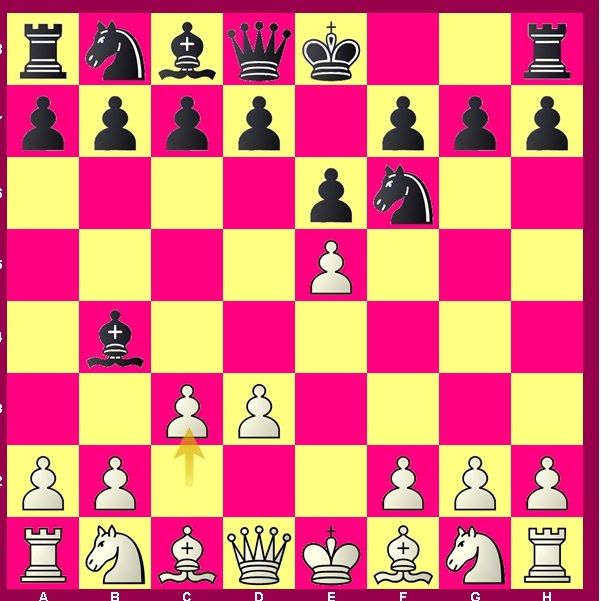
In the diagram above the Black Bishop is attacked by one Pawn and the Black Knight is attacked by another a classis case if a double attack.
- One piece attacks two or more enemy pieces by itself.
- Every fork is a double attack.
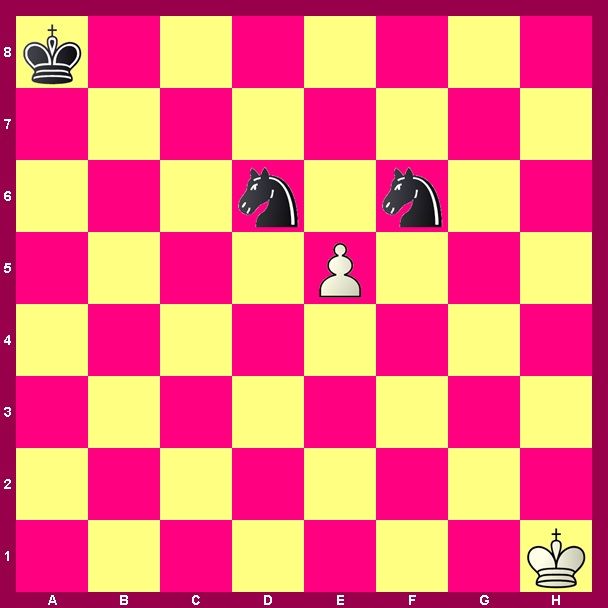
in the diagram above the white Pawn is attacking the 2 knights at once. This is an example of a fork
Many beginning players believe only knights can fork.
That isn't true.
Every chess piece can create a fork.
- Knights can fork.
- Queens can fork.
- Kings can fork.
- Rooks can fork.
- BIshops can fork.
- Even pawns can fork.
Let's look at how many squares each piece can potentially attack:
- Knight = up to 8 squares
- Queen = attacks in 8 directions
- King = attacks 8 nearby squares
- Rook = attacks in 4 directions
- Bishop = attacks in 4 directions
- Pawn = attacks 2 squares
Because the knight attacks in such unusual ways, many chess players call it:
And that brings us to today's lesson.The Knight Fork.
A knight fork is a chess tactic where a knight attacks two or more enemy pieces at the same time.
When performed correctly, the opponent is forced to choose which piece to save.
The other piece is usually lost.
That simple idea has won countless games for children and adults alike.
And once your child learns to spot knight forks, they will begin seeing tactical opportunities everywhere.
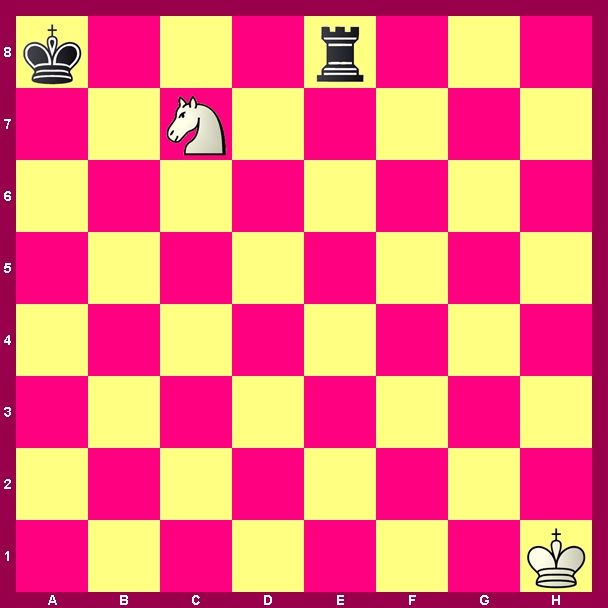
White's Knight is forking the black King and Rook
Jumps
Changes colors
Attacks from strange angles
Loves the center
If two enemy treasures are on the same color squares, start looking for knight forks.
Most chess books teach children how to recognize a fork.
At Chess for Children, we want to go one step further.
We want our students to understand why a fork works and what is stopping a fork from working.
Over the years, I have found that most knight forks fall into three categories:
Pure Forks
Out-of-Position Forks (OPP Forks)
Guarded Forks
Once you understand these three types of forks, finding tactical opportunities becomes much easier.
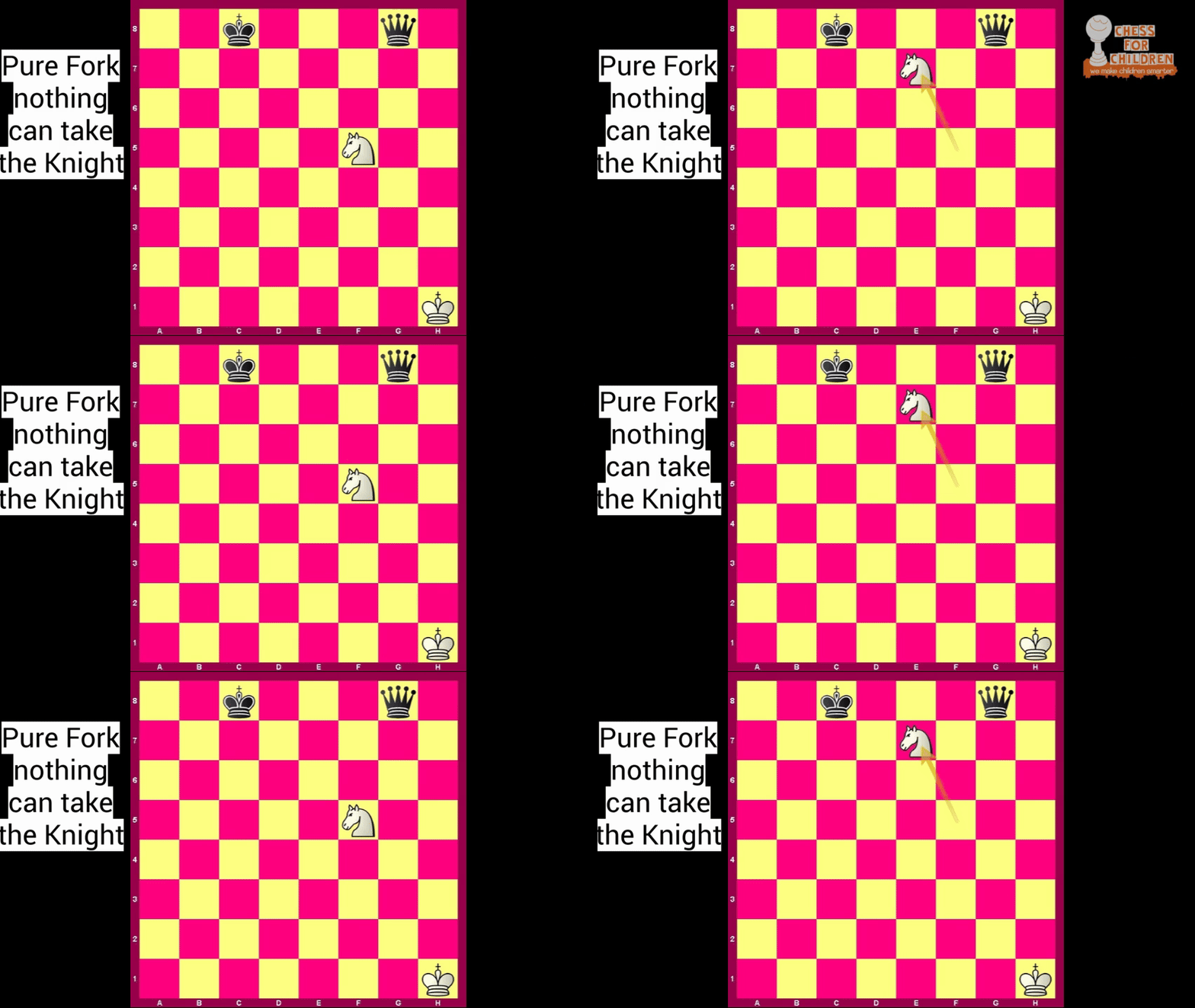
A Pure Fork is a fork that can be played immediately because nothing is stopping it.
The targets are already in the correct position.
The knight can jump to the fork square right now.
No preparation is needed.
No guard must be removed.
No piece must be moved into position.
The fork is ready.
Mr. C's Definition
A Pure Fork is a fork that is ready to be played now. Nothing is stopping the knight from making the fork.
Magnus's Detective Clue🔍
The fork is already there. You just have to find it.
Example 1.
knight can jump to e7 and attack both the King and Queen.
Nothing protects the fork square.
Nothing prevents the move.
The knight simply jumps and wins material.
Pure Forks are often the easiest forks to spot and the most satisfying forks to play.
Sometimes the fork is not ready yet.
The targets are close to being forked, but one of the pieces is not on the correct square.
In these situations we must first move, force, chase, or lure a piece into position.
Only then does the fork become possible.
Mr. C's Definition
An OPP Fork is a fork that is not ready yet because one of the targets is out of position.
First we must move a target into position. Then the fork works.
Magnus's Detective Clue🔍
The fork is hiding. First put the pieces in the right place.
Example
The King and Queen are almost forkable.
A check forces the King onto a different square.
Now the knight can jump and fork both pieces.
The fork did not exist at first.
The player created the fork by moving one of the targets into position
Strong players often see OPP Forks several moves before they happen.
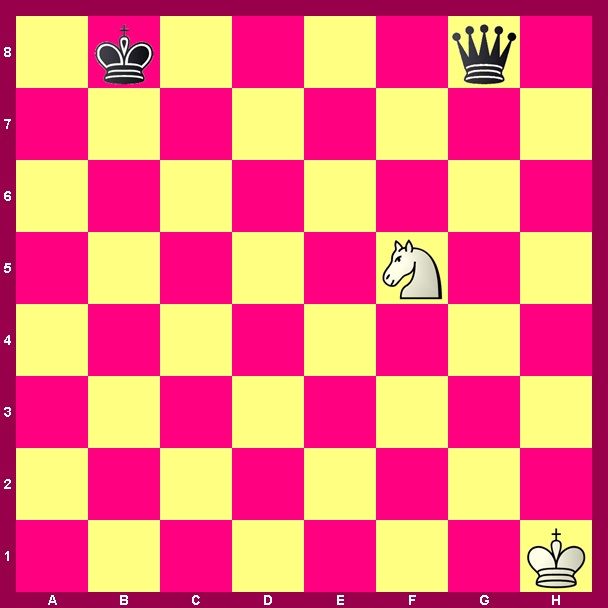
The King and the queen cannot be forked because the King is out of position.
Sometimes the fork is ready.
Sometimes the targets are perfectly placed.
But there is still a problem.
The square where the knight wants to land is guarded by an enemy piece.
The knight cannot safely jump there.
At least not yet.
Mr. C's Definition
A Guarded Fork is a fork that cannot be played because an enemy piece is guarding the fork square.
Magnus's Detective Clue🔍
If the fork square is guarded, don't give up. First find the guard. Then find a way to deal with it.
How Do We Overcome A Guarded Fork?
There are several ways.
1. Pin The Guard
Make the guarding piece unable to move.If the guard cannot move, the fork becomes possible.
2. Capture The Guard
Remove the piece protecting the fork square.No guard means no problem.
3. Distract The Guard
Force the guard to leave its post.Once the guard moves away, the knight can jump in.
4. Ignore The Guard
Sometimes the fork wins so much material that it does not matter if the knight gets captured.For example:The knight forks a King and Queen.The opponent captures the knight.The Queen is still lost.The fork succeeds anyway.
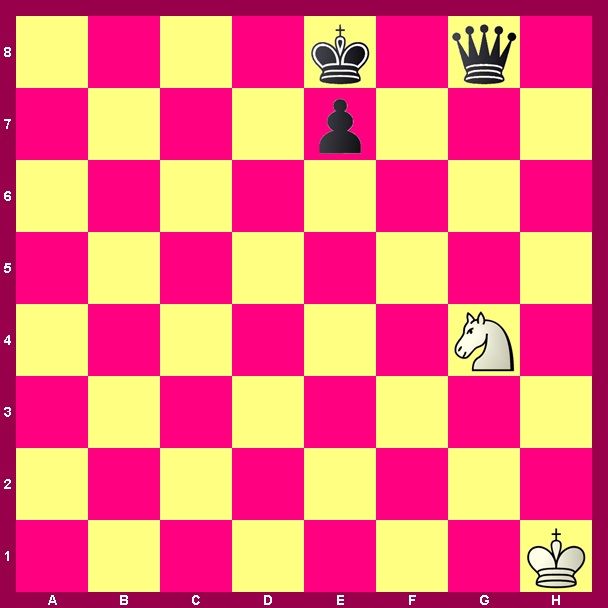
Example of a guarded fork: White would love to fork the King and the Queen of f6 unfortunately the Pawn at e7 would capture the knight.
One way to avoid knight forks is to pay attention to where your valuable pieces are located.
Rule #1: Keep Valuable Pieces on Different Colored Squares
Knights attack pieces most easily when the targets sit on the same color squares.
For example:
King on a light square
Queen on a light square
A knight may be able to jump to a square that attacks both pieces at once.
If your important pieces are on different colored squares, many knight fork opportunities disappear.
Rule #2: Same Diagonal, One Square Apart
There is another useful clue.
When two valuable pieces are on the same diagonal and separated by one square, a knight cannot fork them both.
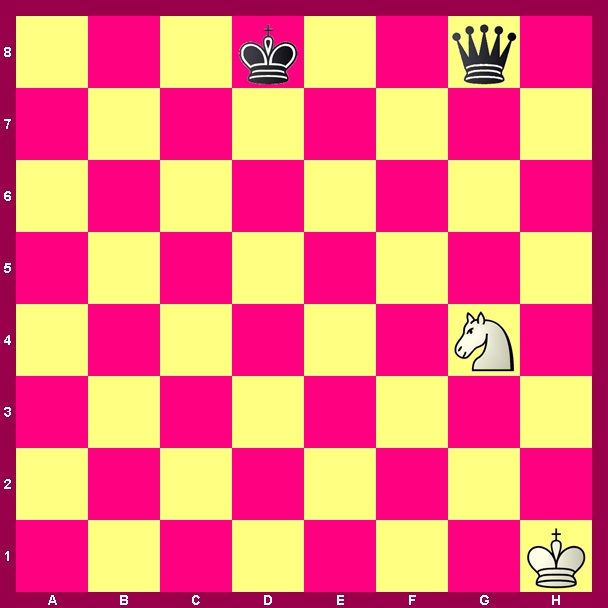
There is no fork because the King and Queen are on different color squares
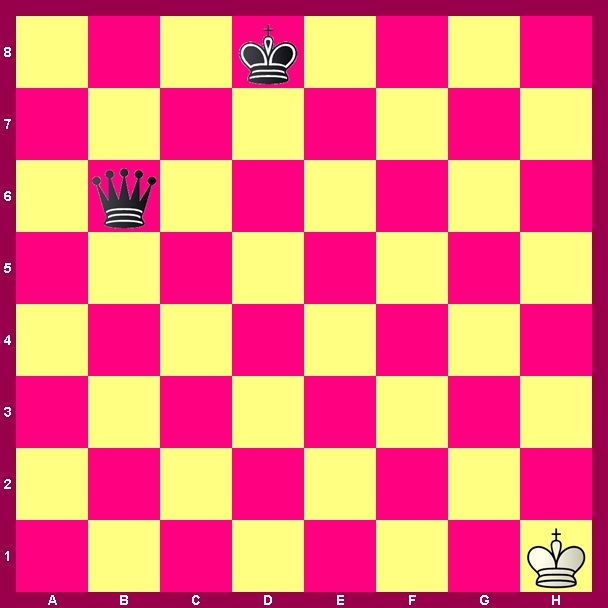
No matter where you place a knight its impossible to fork black
A Family Fork is a special type of Knight fork where the Knight attacks the King, Queen and Rook.
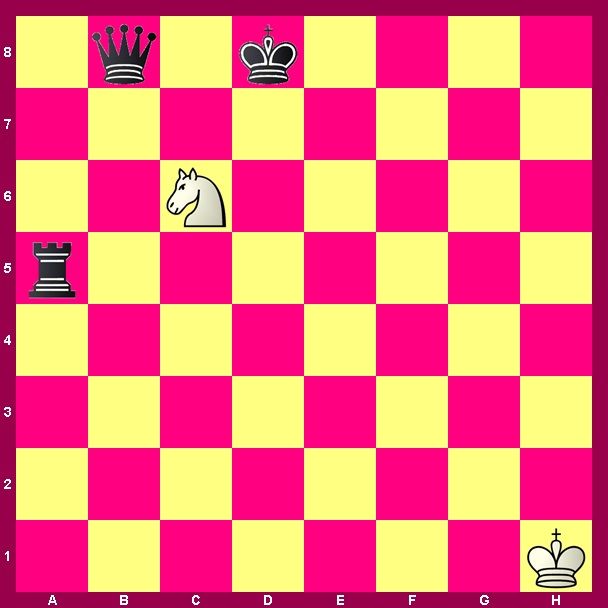
The Knight attacks the King , Queen and Rook ,. A classic example of the Family Fork
A knight cannot fork pieces at random.
Certain patterns make forks possible.
As a Chess Detective, Magnus looks for clues.
Clue #1: Same Colored Squares
If two valuable enemy pieces are sitting on the same colored squares, a knight fork may be possible.
Knights change colors every move.
This often allows the knight to attack both pieces at the same time.
Clue#2: Same Diagonal, One Square Apart
If two valuable pieces are on the same diagonal and separated by one square, a knight usually cannot fork them.
This is a great defensive pattern.
Strong players often use it to avoid forks.
Clue #3: Centralized Knight
A knight in the center controls up to 8 squares.
A knight on the edge controls only 4.
A knight in the corner controls only 2.
The closer your knight is to the center, the more fork opportunities it will find.
Magnus's Detective Clue 🔍
Before every move ask:
1) Are two valuable pieces on the same color?
2) Is my knight near the center?
3) Is there a fork square available?
4) Can I move a piece into position to create a fork?
5) Are any of my opponent's pieces out of position?
Before every move ask yourself:
Is there a Pure Fork?
Can I fork right now?
Is there an OPP Fork?
Can I move a target into position?
Is there a Guarded Fork?
Can I remove, pin, distract, or ignore the guard?
The player who asks these questions will find far more forks than the player who simply looks for knight jumps.
Remember:
A fork is not just a move.
A fork is a mystery waiting to be solved.
And every good Chess Detective knows how to follow the clues.
En Prise in Chess: The First Tactic Every Child Should Learn
Meet jess: The online chess Adventure Your Child will love
Does Chess Really Make Kids Smarter!