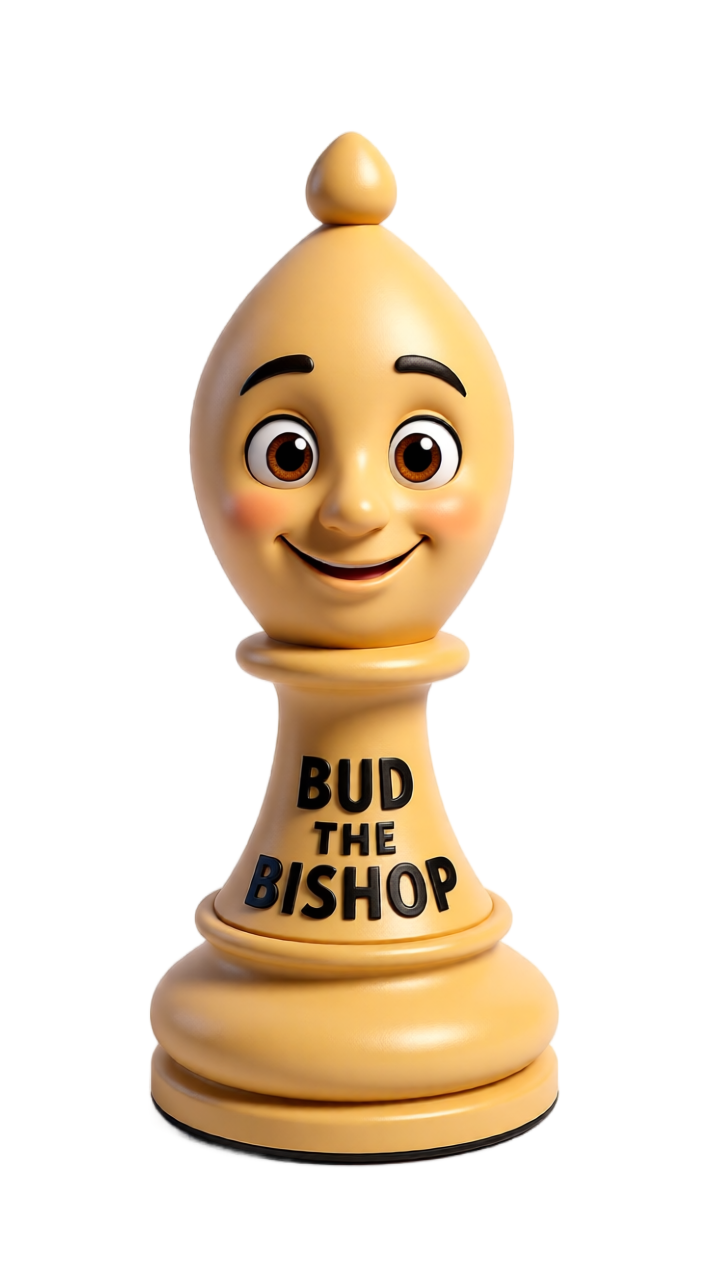
Meet Bud the Bishop!
Help your child discover diagonal movement, recognize light and dark squares, and learn how one of chess's most graceful pieces travels across the board.
The Bishop's Hat Gives Us a Clue
When toddlers first see a bishop, the piece may look unusual. It has a round shape and what children often describe as a funny-looking hat.
Instead of asking children to memorize the bishop's movement, we can use the shape of the piece to help them understand it. The slant on top of the bishop reminds us of a diagonal line.
This is one of the most important ideas in the lesson. We are not simply telling children where a piece goes. We are helping them recognize a pattern.
When children understand the pattern, they no longer need to depend entirely on memory. They can examine the board and work out the answer for themselves.
Watch Part 7: The Bishop
In this lesson, National Master Ernest Colding introduces the bishop and shows parents how to explain diagonal movement in a simple, toddler-friendly way.
Meet Bud the Bishop
Bud the Bishop is your child's friendly guide for this lesson. Bud loves traveling along the board's slanting roads.
By giving the bishop a friendly name and personality, we transform an abstract chess piece into a character that a toddler can recognize and remember.
- Bud travels diagonally.
- Bud can move forward or backward.
- Bud stays on the same color squares.
- Bud cannot jump over another piece.
Mr. C's Teaching Principle
Children remember ideas best when those ideas are connected to something they can see, touch or imagine.
Bud's slanting hat gives the child a visual clue. The clue leads to understanding, and understanding is stronger than memorization.
Three Simple Rules for the Bishop
The Bishop Moves Diagonally
A bishop moves along slanting lines. It does not move straight forward, straight backward or directly sideways.
The Bishop Stays on One Color
A bishop that begins on a light square will always remain on light squares. A bishop that begins on a dark square will always remain on dark squares.
The Bishop Cannot Jump
A bishop may travel across many squares, but its path must be clear. Another piece standing in its way stops the bishop.
How to Teach Your Toddler a Diagonal
Before asking your child to move a bishop, make sure your child understands what a diagonal looks like.
Step 1: Use an Empty Board
Remove the other chess pieces and place one bishop near the center of the board. An empty board makes the bishop's movement easier to see and prevents unnecessary confusion.
Step 2: Find the Slanting Roads
Ask your child to point to the slanting paths leading away from the bishop.
Step 3: Slide the Bishop
Let your child slide Bud along one diagonal. Begin with one or two squares. Later, allow the bishop to travel farther.
- Can Bud move straight ahead?
- Can Bud move sideways?
- Which roads are diagonal?
- Can Bud move backward diagonally?
- What happens if another piece blocks the road?
The Bishop's Color-Square Secret
Each player begins with two bishops. One starts on a light square, and the other starts on a dark square.
Because bishops move diagonally, each bishop remains on the same color for the entire game.
Try the Same-Color Challenge
Place a bishop on a light square. Ask your child to move it to any legal square.
After each move, ask:
“Is Bud still standing on the same color?”
Continue for several moves. Then repeat the activity using the other bishop on a dark square.
Your child will discover that the two bishops belong to two different color families.
The Bishop Cannot Jump
The bishop can move a long distance, but only when the diagonal road is open.
Place a pawn directly in the bishop's diagonal path. Ask your child:
If an opponent's piece is blocking the diagonal, the bishop may capture that piece by landing on its square. However, it cannot continue beyond the captured piece during the same move.
Practice with the Rook, Bishop and Pawn Game
Let your child practice bishop movement while reviewing the rook and pawn lessons from earlier parts of the series.
If the game does not open inside the page, use the button below.
Open the Practice GameDownload the Free Bishop Activity Book
Continue the lesson away from the screen with the Bishop chapter from Teach Your Child Chess in Ten Easy Lessons.
The printable pages include bishop movement, same-color square practice, blocked bishop exercises, capturing challenges, the Rook-Bishop-Pawn game and Bishop Chess Jeopardy.
Download the Free Bishop Activity BookWhat Your Child Is Really Learning
This lesson is about much more than moving a chess piece.
Pattern Recognition
Your child learns to recognize diagonal lines and visual patterns across the chessboard.
Careful Observation
Your child notices the color of the squares and determines whether the bishop's path is open.
Planning Ahead
Your child begins looking beyond the first square and imagining where the bishop may travel next.
Tips for Parents
- Keep the lesson short and playful.
- Use the word “diagonal” frequently.
- Let your child touch and move the bishop.
- Celebrate correct movement immediately.
- Do not criticize every mistake.
- Review earlier pieces before adding new ideas.
- Stop while your child is still enjoying the lesson.
Success Is More Important Than Speed
Your child does not need to master every bishop rule in one lesson.
A few successful moves are enough. Return to the activity later and let understanding grow naturally.
Frequently Asked Questions
How does a bishop move in chess?
A bishop moves diagonally in any direction for as many open squares as are available.
Can a bishop move on both light and dark squares?
No. A bishop that begins on a light square always remains on light squares. A bishop that begins on a dark square always remains on dark squares.
Can a bishop jump over another chess piece?
No. A bishop must have a clear diagonal path and cannot jump over another piece.
Can the bishop move backward?
Yes. A bishop may move diagonally forward or backward.
How does a bishop capture?
The bishop captures the same way it moves: diagonally. It lands on the opponent's square, and the captured piece is removed.
How long should I practice with my toddler?
A few enjoyable minutes may be enough. Stop before your child becomes tired or frustrated and return to the lesson another day.
Should my toddler memorize how the bishop moves?
Focus first on helping your child understand what a diagonal is. Understanding the pattern is more valuable than simply memorizing the rule.
Continue the Teach Your Toddler Chess Series
Review earlier lessons regularly. Every new piece builds upon ideas your child has already learned.
Would You Like Help Teaching Your Child?
National Master Ernest Colding has helped thousands of children learn to think, solve problems and build confidence through chess for more than 40 years.
Explore Chess Lessons for My Child