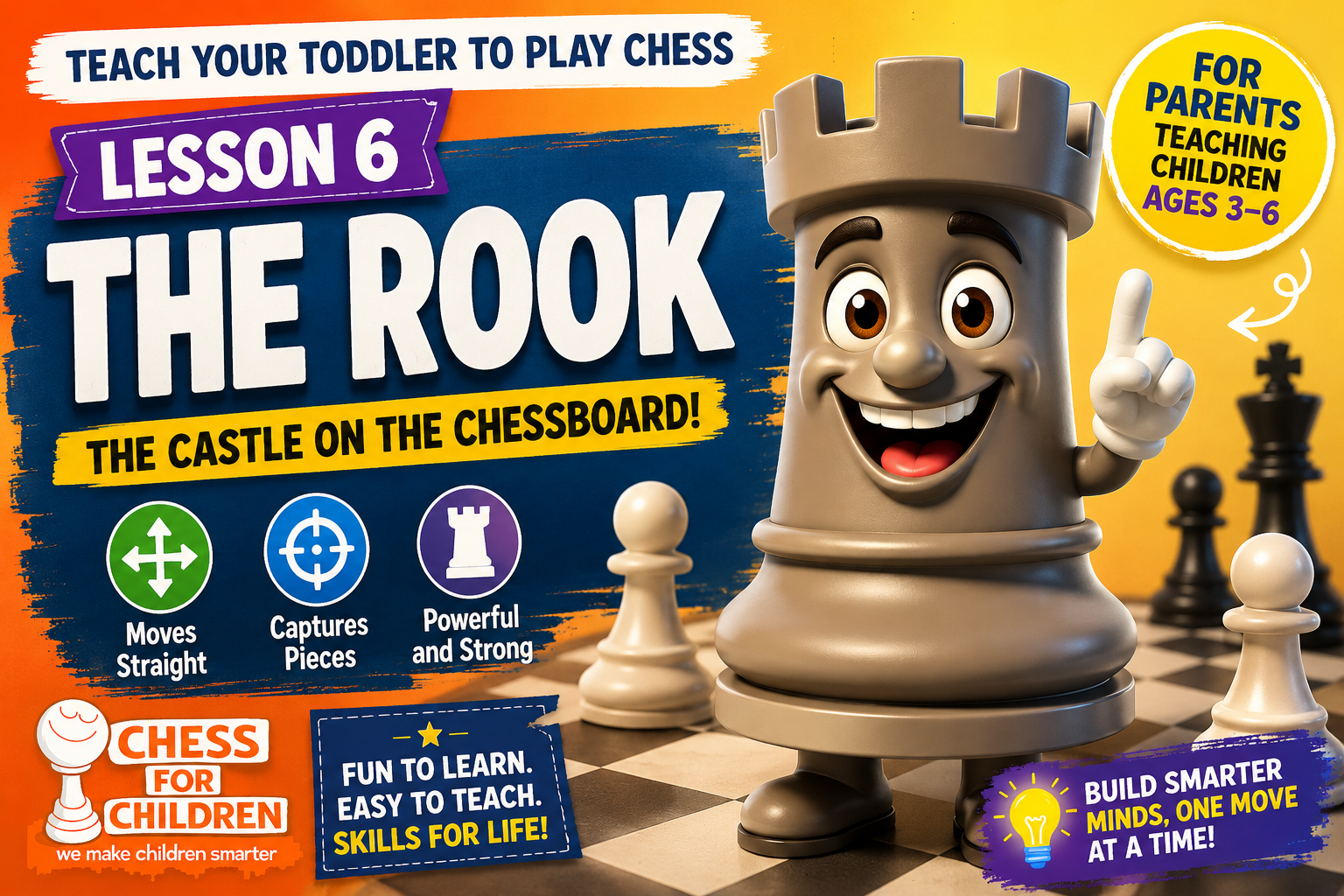
Teach Your Toddler to Play Chess – Part 6: The Rook
The rook is one of the easiest pieces for young children to understand because it moves in straight lines. In this lesson, parents will learn how to teach the rook using simple words, fun activities, and a printable workbook.
Help your child understand that the rook moves up, down, left, and right — but never diagonally and never by jumping over pieces.
Watch the Lesson
Why the Rook Is a Great Piece for Toddlers
When we teach very young children chess, we do not want to overload them. We want to give them one clear idea at a time. The rook is a wonderful beginner piece because its movement is easy to see.
The rook does not twist. It does not hop. It does not move diagonally. It travels in straight lines: up and down, side to side.
“If it has a castle look, then you’re looking at a rook.”
The Rook Rhyme
Children remember rhythm. That is why I like to teach the rook with a simple rhyme:
then you’re looking at a rook.
Along straight lines rooks do ride,
up and down, and side to side.
How the Rook Moves
Place a rook in the middle of an empty chessboard. Ask your child:
- Can the rook go up?
- Can the rook go down?
- Can the rook go side to side?
- Can the rook move diagonally?
Let your child answer by moving the piece. This is important. Children learn better when their hands are involved.
Do not rush to correct every mistake. Ask questions. Let your child think. Thinking is where the learning happens.
The Rook Cannot Jump
One of the first rook rules children must understand is that the rook cannot jump over pieces.
I explain it like this:
“The rook travels on roads. If another piece blocks the road, the rook must stop.”
This makes the idea simple. A blocked road is something even a young child can understand.
How the Rook Captures
The rook captures the same way it moves. If an enemy piece is on the same row or column, and there is nothing in the way, the rook can capture it.
Keep the explanation short:
- The rook moves straight.
- The rook captures straight.
- The rook cannot jump.
Try the Rook and Pawn Game
After your child understands how the rook moves, the best next step is a mini-game. The Rook and Pawn Game lets children practice movement, capturing, and planning without needing to play a full chess game.
Click below to play:
Download the Free Rook Activity Book
I created a printable Rook Activity Book to go with this lesson. It includes practice pages, challenges, and review questions parents can use at home.
📥 Download the Free Rook Activity Book
Common Mistakes Parents Make
1. Teaching too much at once
Do not teach the rook, bishop, queen, king, and knight all in one session. Young children need time to absorb one idea.
2. Explaining instead of playing
Toddlers learn by doing. Let them move the rook. Let them test ideas. Let them make mistakes.
3. Making chess feel like schoolwork
Chess should feel like play. If the child is laughing, touching the pieces, and asking questions, you are doing it right.
Parent Practice Plan
- Say the rook rhyme together.
- Place the rook on an empty board.
- Ask your child to move it up, down, left, and right.
- Add a few pawns as obstacles.
- Ask which pieces the rook can capture.
- Play the Rook and Pawn Game.
- Complete the printable activity book.
The Bigger Lesson
The rook teaches more than chess. It teaches direction, attention, patience, and problem solving. When a child learns that the rook cannot jump, they are also learning to notice obstacles and plan around them.
That is why chess is such a powerful learning tool for young children. Every piece teaches a thinking habit.
Want Help Teaching Your Child Chess?
Chess for Children offers private lessons, online lessons, and parent-friendly resources to help children learn chess the right way.
Learn About Private Chess Lessons