Teach Your Toddler Chess – Part 3: Setting Goals
Teach Your Toddler Chess – Part 3: Setting Goals
Small Goals, Big Success
One of the biggest mistakes parents make when teaching their children chess has nothing to do with chess.
It has to do with goals.
Many parents hope their child will become a strong player. Some dream of trophies, championships, and tournament victories. Others simply want their child to develop focus, confidence, and critical thinking skills.
There is nothing wrong with any of those hopes.
The problem begins when adults start measuring success by things children cannot control.
Winning.
Getting a trophy.
Becoming a champion.
Beating other children.
These are outcomes.
Goals should be something a child can control.
After more than 40 years of teaching children, I have discovered that the children who stay with chess the longest are rarely the ones obsessed with winning.
Instead, they are the children who learn how to set goals, work toward them, overcome obstacles, and celebrate progress.
The wonderful thing is that even very young children can learn this skill.
In fact, learning how to set goals may be one of the most valuable lessons chess has to offer.
My First Six Tournaments
Many parents are surprised when I tell them this story.
I lost my first six chess tournaments.
Not six games.
Six tournaments.
Imagine if my goal had been to win.
I would have considered myself a failure six times in a row.
Fortunately, I learned something important.
Winning wasn't the goal.
Learning was the goal.
After every tournament I asked myself:
What did I learn?
What mistake can I fix?
What can I do better next time?
Little by little, I improved.
The lesson was simple.
Success isn't about where you are today.
Success is about whether you are moving forward.
That's the lesson I try to teach every child I work with.
The Wrong Goals
Young children need goals they can understand and achieve.
Unfortunately, many adults accidentally give children goals that create frustration.
Examples include:
Win every game.
Never make mistakes.
Become a master.
Beat everyone in the class.
Win the tournament.
These goals create pressure.
Pressure creates fear.
Fear often causes children to stop enjoying the game.
The truth is that even world champions lose games.
Making mistakes is part of learning.
Losing is part of learning.
Improvement is part of learning.
Children need goals that encourage growth rather than perfection.
The Right Goals
A good goal is something a child can control.
For toddlers and beginners, goals should be simple.
Examples include:
Learn the names of the pieces.
Set up the board correctly.
Remember how the knight moves.
Learn what check means.
Play a complete game.
Shake hands before and after every game.
Look at every piece before making a move.
Notice that none of these goals require winning.
Yet every one of them helps a child become a stronger player.
Most importantly, these goals build confidence.
When children experience success, they become eager to tackle bigger challenges.
Goals for Ages 3–4
At this age, chess should be playful.
Goals might include:
Naming the pieces.
Finding the king.
Learning how the rook moves.
Setting up the board.
Sitting and concentrating for five minutes.
These may seem like small accomplishments to adults.
For a young child, they are enormous victories.
Goals for Ages 5–7
Children at this age can begin working toward more structured goals.
Examples include:
Play a complete game.
Learn how all the pieces move.
Spot a simple checkmate.
Solve easy puzzles.
Learn basic sportsmanship.
These goals help build confidence while preparing children for future challenges.
Goals for Ages 8–10
Older children may begin setting competitive goals.
Examples include:
Play in a first tournament.
Score a first point.
Earn a first rating.
Win a first trophy.
Help another student improve.
Notice that helping others is included.
Chess should not only build strong players.
It should build strong people.
The Tournament Ladder
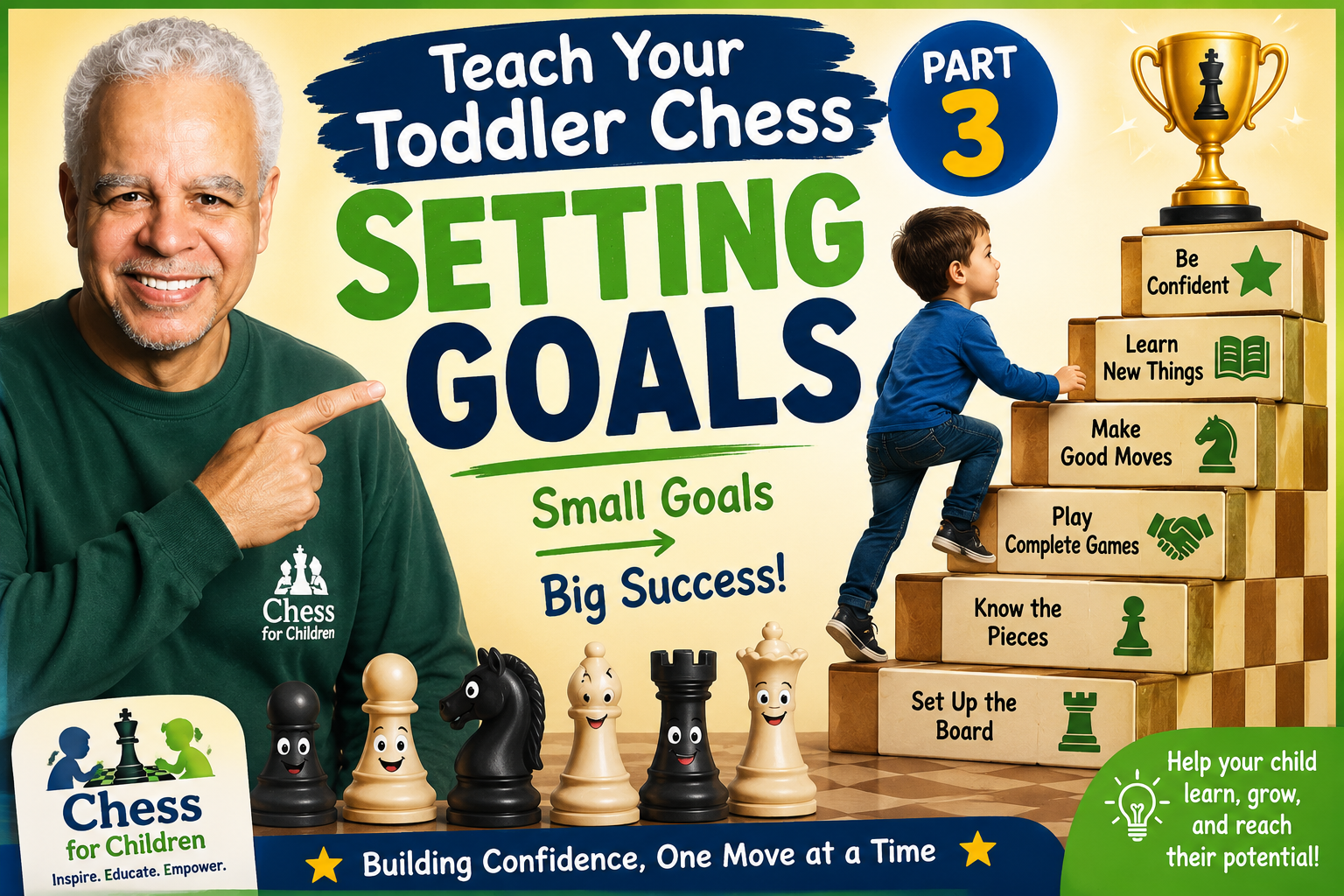
I often encourage students to think of tournament chess as a ladder.
Step 1: Play Your First Tournament
Simply showing up is a success.
Step 2: Score Your First Point
Every player remembers their first tournament victory.
Step 3: Score 50%
Now consistency becomes the goal.
Step 4: Win a Trophy
An exciting milestone.
Step 5: Develop Good Habits
Good sportsmanship.
Good preparation.
Good effort.
Step 6: Become a Leader
The best players eventually help younger children learn and grow.
That may be the most important goal of all.
My Rule as a Teacher
Over the years I have developed a simple philosophy.
When a child doesn't understand something, I don't blame the child.
I blame myself.
After all, it is my job to explain it in a way the child can understand.
Children learn differently.
Some need to see it.
Some need to hear it.
Some need to do it.
A good teacher keeps searching until the lesson connects.
That belief led to one of my proudest teaching experiences.
Sometimes One Goal Changes Everything
Many years ago, I was working at a chess camp with several outstanding chess teachers.
One day, the camp directors asked us which children we wanted to work with.
My answer surprised them.
"I want the children no one else wants to work with."
As a result, I was assigned a young girl who was struggling badly with chess.
At first I couldn't understand why.
Then I discovered the problem.
She didn't know what a diagonal was.
To an experienced player, that may not sound important.
But if you don't understand diagonals, much of chess becomes confusing.
For three days I tried to teach her.
I explained.
I demonstrated.
I drew pictures.
I tried every method I could think of.
Nothing seemed to work.
I became frustrated.
Not with her.
With myself.
I knew I wasn't getting through.
Then on the fourth day, she came running into the room.
"Mr. C! Mr. C! I know what a diagonal is!"
I smiled.
"Really? Show me."
And she did.
She finally understood.
The amazing thing was what happened next.
Once she learned that one concept, everything else became easier.
The bishops made sense.
The board made sense.
The lessons made sense.
She quickly began catching up with the other children.
I told her how proud I was of her.
For the first time, she could fully participate with the group.
To this day, that remains one of my proudest teaching moments.
Not because someone won a championship.
Not because someone earned a trophy.
But because I got to see the light come on in a child's eyes.
Together we had set a goal.
Together we had conquered it.
Sometimes it isn't ten obstacles holding a child back.
Sometimes it's one.
One skill.
One concept.
One goal.
And when that hurdle is cleared, everything changes.
The Boy Everyone Underestimated
Another student taught me a similar lesson.
His father was a strong chess player who believed chess could help his son succeed in life.
The boy had been identified as being on the autism spectrum, and many people were reluctant to work with him.
Before I agreed to teach him, I watched him at a tournament.
What impressed me had nothing to do with chess.
Another boy had just lost a game and was feeling terrible about himself.
The student everyone described as "difficult" quietly sat down beside him.
Together they reviewed the game.
As they looked at the moves, he pointed out the things the other boy had done well.
He encouraged him.
He complimented him.
He helped him see that despite losing, he had played many strong moves.
Little by little, the discouraged boy began to feel better.
Watching this, I realized something.
I wasn't looking at a difficult child.
I was looking at a kind child.
A generous child.
A child with tremendous heart.
When his father later asked me to teach him, I said yes.
As I got to know him, I discovered he was incredibly ambitious.
So together we developed a plan built around goals.
Small goals.
Achievable goals.
The kind that build confidence.
At first progress was slow.
But he kept achieving goal after goal.
His confidence grew.
His chess improved.
His ambitions expanded.
Eventually, he became one of the strongest junior players in the country.
But what I remember most is not the trophies.
It's the kindness he showed another child.
That experience reinforced something I have seen throughout my career.
Never underestimate a child.
Children are capable of extraordinary growth when someone believes in them.
The Real Purpose of Goals
The purpose of chess is not to create champions.
Champions are wonderful.
But they are not the most important thing.
The real purpose of chess is to help children develop life skills.
Goal setting.
Perseverance.
Discipline.
Patience.
Resilience.
Confidence.
These qualities help children succeed in school, relationships, careers, and life.
Chess simply provides a wonderful environment in which to practice them.
Final Thoughts
If you're teaching a toddler chess, don't worry about ratings.
Don't worry about trophies.
Don't worry about championships.
Focus on the next step.
Celebrate small victories.
Encourage effort.
Reward improvement.
Remember that every great achievement begins with a single goal.
Sometimes that goal is learning how a knight moves.
Sometimes it's learning what a diagonal is.
Sometimes it's simply having the courage to play your first game.
Whatever the goal may be, help your child take the next step.
Because small goals create big success.
Coming Next"I have taught national champions.
Teach Your Toddler Chess – Part 4: The First Chess Activities Every Young Child Can Enjoy