Teach Your Toddler Chess – Part 5
How to Teach Your Child the Pawn
By National Master Ernest Colding
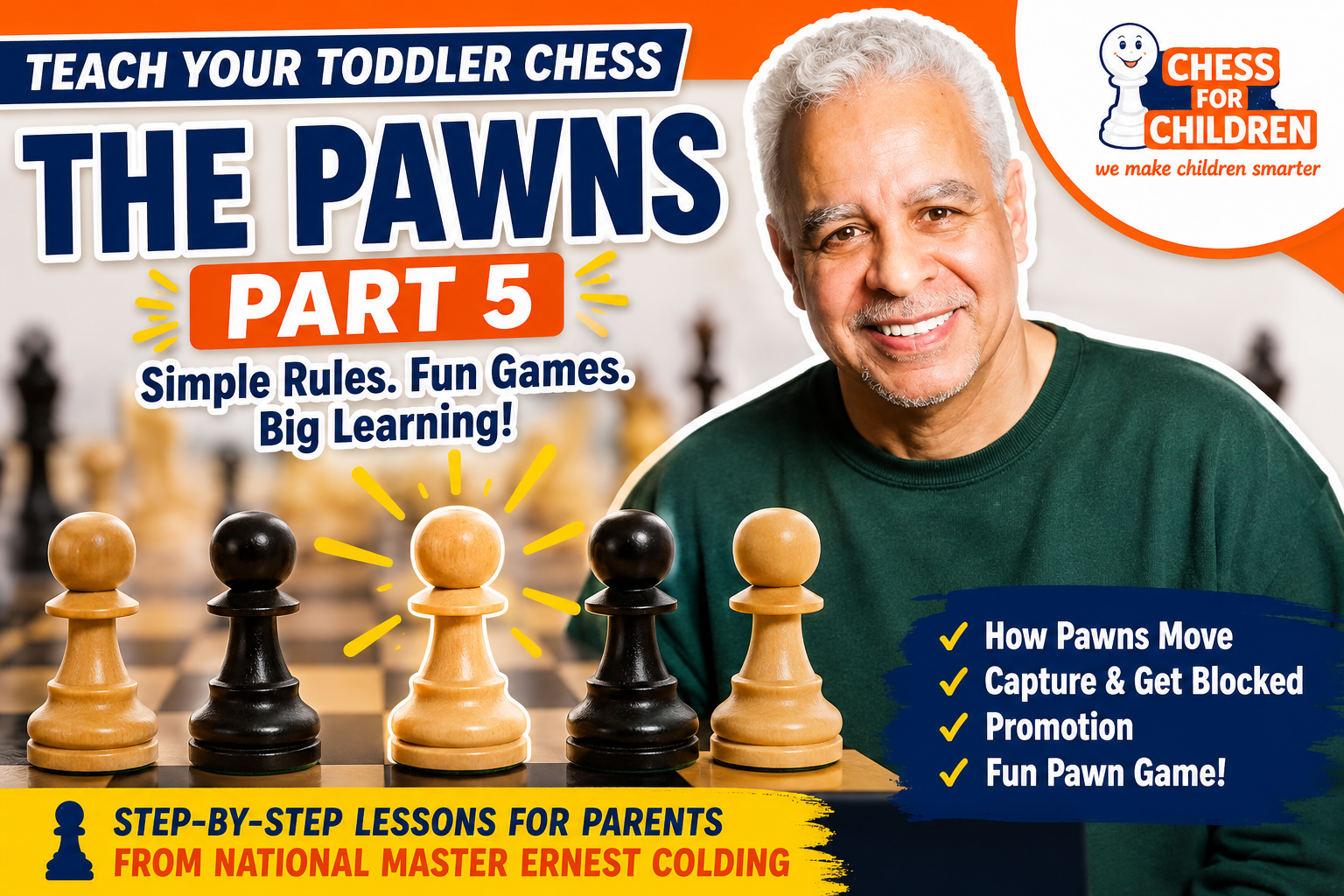
🎥 Watch the Lesson First
Parents, watch this lesson with your child. Then use the guide below, the practice app, and the activity book to reinforce the lesson.
📚 In This Lesson Your Child Will Learn
✅ How pawns move forward
✅ The special two-square first move
✅ How pawns capture diagonally
✅ What happens when a pawn is blocked
✅ How pawns promote
✅ How to play the Pawn Game
Welcome to Lesson 5: The Pawn
Welcome back to our free Teach Your Toddler Chess series. Today your child learns the first chess piece: the pawn.
The pawn may be the smallest piece on the board, but it teaches some of the biggest ideas in chess. Once your child understands the pawn, every other piece becomes easier to learn.
Why We Start With the Pawn
Many parents make the mistake of teaching every chess piece at once. Don’t. Children learn better when they master one small idea at a time.
The pawn is perfect because it is simple, brave, and easy to understand.
“The Pawn is smallest, that is true, but he is kind and brave and true.”
Rule 1 – Pawns Move Forward
“A Pawn can move in just one way — forward is the way they play.”
Place one white pawn and one black pawn on the board. Show your child that each pawn moves forward toward the other side of the board.
Parent Activity
Ask your child: “Which way is forward?”
Let them move one pawn forward. Praise them immediately. Then let them move another pawn.
Rule 2 – One Square or Two
“A Pawn can move one square or two — that is what a Pawn can do.”
A pawn may move one or two squares on its very first move. After that, it may only move one square at a time.
Rule 3 – Blocked Pawns
If something is directly in front of a pawn, the pawn cannot move. Pawns cannot jump over pieces.
Rule 4 – Pawns Capture Diagonally
This is the rule that surprises many beginners.
“Pawns walk straight, but fight diagonally.”
Show your child a pawn with an enemy piece diagonally in front of it. The pawn may capture that piece by moving onto its square.
How to Capture With a Pawn
1. The pawn attacks diagonally.
2. The pawn moves onto the enemy pawn’s square.
3. The captured pawn is removed from the board.
Rule 5 – Promotion
Children love this rule.
“When on the last row a Pawn is seen — it can then become a Queen.”
Your child does not need to master promotion today, but they should know that a pawn can become powerful if it reaches the other side.
🎮 Mr. C’s Practice Lab
Practice the Pawn!
Today’s Mission:
✅ Move forward
✅ Use the two-square first move
✅ Recognize blocked pawns
✅ Capture diagonally
⭐ Estimated time: 10–15 minutes
🟢 Start the FREE Interactive Pawn Practice📖 Reinforce Today’s Lesson
After the video and practice app, complete the matching activity book pages with your child.
This helps turn the lesson into real understanding.
♟️ Play the Pawn Game
Now your child is ready for their first mini chess game.
How to Play
1. Set up only the pawns.
2. White moves first.
3. Try to get one pawn to the other side.
4. You may also win by capturing all your opponent’s pawns or leaving them with no legal moves.
Parent tip: Your goal is not to beat your child. Your goal is to help your child understand.
🎓 Homework for Today
✅ Watch the lesson.
✅ Complete the Pawn Practice App.
✅ Finish the activity book pages.
✅ Play one Pawn Game with a parent.
🎉 Great Job!
Today your child learned how pawns move, capture, get blocked, promote, and play a complete pawn game. That is a tremendous accomplishment.