How to Teach Your Toddler Chess: The Queen
Help your child discover the strongest chess piece with a simple rhyme, an easy video lesson, playful activities and a free printable Queen workbook.
Watch the Queen Lesson
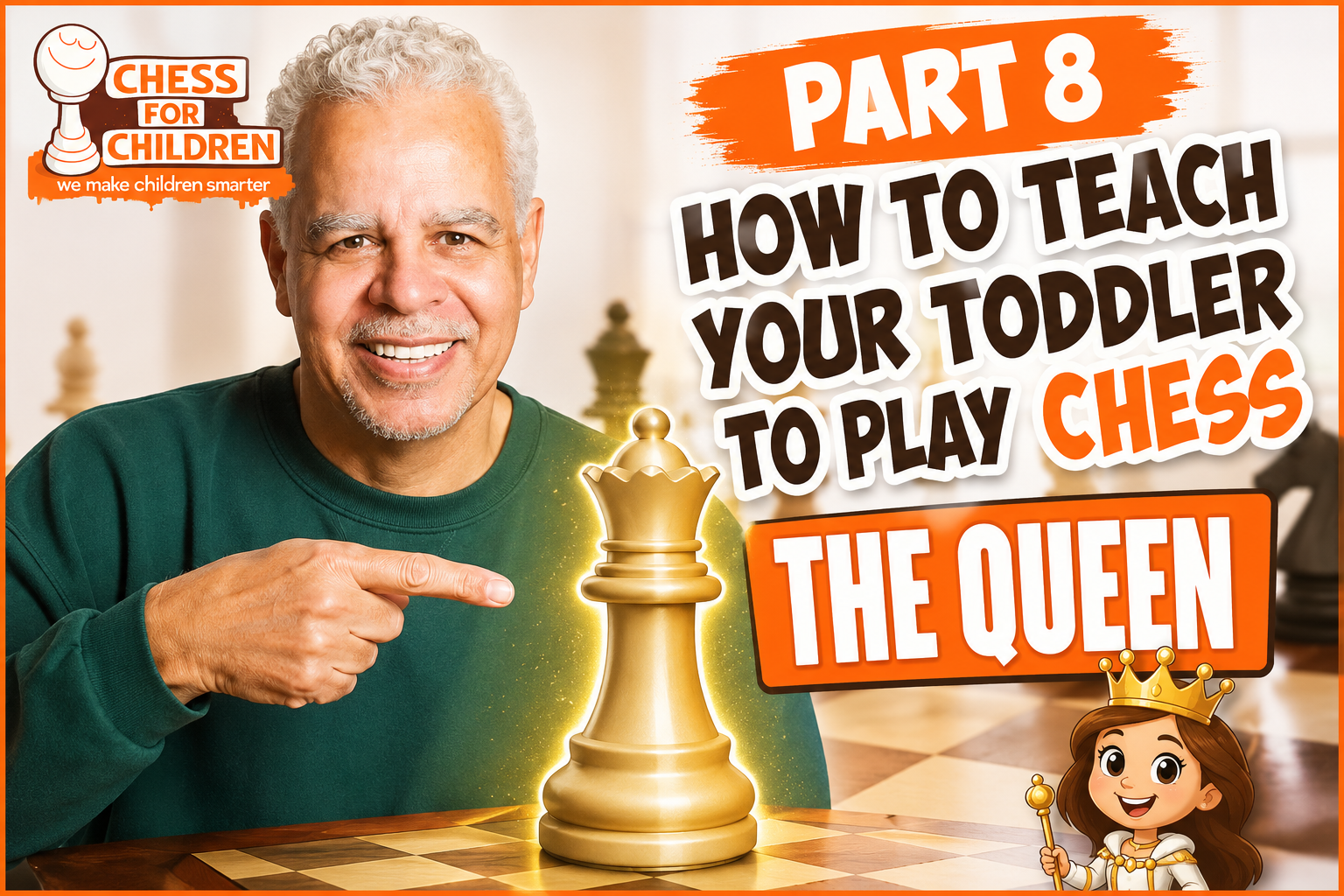
In this beginner-friendly lesson, National Master Ernest Colding shows parents and children how the Queen moves, where she begins the game and how she captures other chess pieces.
Meet the Queen
The Queen is the strongest and most powerful piece on the chessboard. She combines the movement of the Rook and the Bishop.
her powers show that she’s the best.
To move the Queen, this is the key:
along straight lines and diagonally.”
Four Easy Queen Lessons
Find the Queen
Show your child the Queen. Explain that she usually has a crown and is taller than most of the other pieces.
Place the Queen
Teach the simple rule: the Queen begins on her own color. The White Queen starts on a light square, and the Black Queen starts on a dark square.
Move Like a Rook and Bishop
The Queen moves up, down and side to side like a Rook. She also moves diagonally like a Bishop.
Do Not Jump
The Queen cannot jump over another piece. She must stop before her own piece or capture an opposing piece where it stands.
Download the Free Queen Workbook
Use the printable pages from Teach Your Child Chess in Ten Easy Lessons to review Queen movement, placement, capturing and practice challenges.
Fun Queen Activities for Children
- Place the Queen in the center and ask your child to point to every direction she can travel.
- Put friendly pieces around the Queen and ask where she must stop.
- Add opposing pieces and ask which ones the Queen can capture.
- Ask your child to move the Queen like a Rook and then like a Bishop.
- Practice the rule “Queen on her own color” during chessboard setup.
Play the Queen, Rook, Bishop and Pawn Game
How to Play
- Set up the Queens, Rooks, Bishops and Pawns for both players.
- Choose who will play White and who will play Black.
- Play until one player captures all the opposing pieces or one side has no legal moves remaining.
- Switch colors and play again.
- Keep the game cheerful, encouraging and fun.
Tips for Teaching Toddlers and Young Children
- Keep each practice session short—about five to ten minutes.
- Use praise whenever your child correctly identifies a Queen move.
- Do not introduce too many rules during one sitting.
- Let your child physically move the Queen instead of only watching.
- Repeat the rhyme to make the movement easier to remember.
- Stop while your child is still having fun.
Frequently Asked Questions
How does the Queen move in chess?
The Queen moves any number of open squares up, down, side to side or diagonally.
Can the Queen jump over other chess pieces?
No. The Queen cannot jump over her own pieces or an opponent’s pieces.
Where does the Queen begin the game?
Each Queen starts on a square matching her color: the White Queen on a light square and the Black Queen on a dark square.
How does the Queen capture?
The Queen captures in the same directions she moves. She lands on the opponent’s square, and the captured piece is removed.
Why is the Queen the strongest chess piece?
The Queen combines the straight-line movement of the Rook with the diagonal movement of the Bishop, giving her control over many squares.
Continue Your Child’s Chess Adventure
Watch the full lesson series, explore more free chess activities and discover programs created especially for young learners.